Blask: Brazil’s domestic online betting collapsed while offshore demand held steady
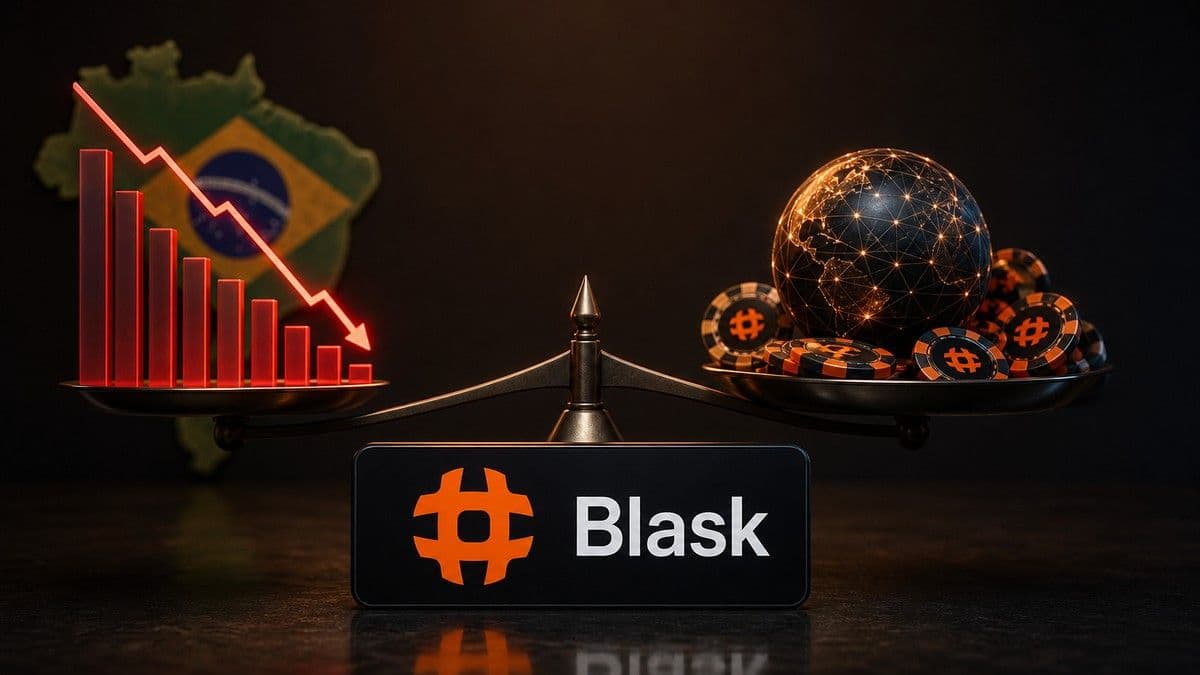
Domestic demand fell 78% in a week from Sept 25 while offshore users stayed near 280k–295k.
Key Takeaways
- Blask recorded a two-step collapse in Brazil's domestic online betting after the 25 September provisional measure.
- Demand for offshore providers stayed roughly constant at about 280,000–295,000 users across three Fridays.
- Total measured betting in Brazil fell 78% from the decree day to 2 October, while local demand fell 82% and international demand fell 4%.
- Offshore providers’ market share rose from about 5% to 28% because the licensed market shrank, not because international demand substantially grew.
Blask reported that domestic online betting demand in Brazil collapsed in two clear steps across three Fridays beginning 25 September 2026, while demand for offshore providers remained essentially unchanged at roughly 280,000–295,000 users. The collapse followed a provisional measure from the federal government that began curbing domestic online gaming; the prohibition on domestic suppliers remains subject to congressional approval and is being challenged before Brazil's Supreme Court.
Blask's data: two-step collapse and a stable offshore base
The Blask Index for Brazil registered 5.71 million on 25 September: 5.41 million for local operators (94.83% of the market) and 294,900 for international providers (5.17%). After the government moved to restrict licensed domestic operators, Blask measured a sequence of changes across three Fridays.
Blask described the pattern as a two-step collapse for local demand. Local operator demand fell from 5.41 million on 25 September to 959,000 on 2 October under a phased shutdown. By 9 October — after licensed sites went offline on 6 October — local demand was 725,000. Over the same interval, demand for offshore providers was remarkably constant: 294,900 on 25 September; about 282,000 on 2 October; and 283,000 on 9 October. Blask summarised the week-on-week change: total demand fell 78% from the decree day to 2 October, local demand fell 82%, and international demand fell only 4%.
"International [-provider] demand did not grow: it stayed at around 280,000 to 295,000 across all three Fridays," Blask said.
Market share shifted because the licensed market shrank
Blask emphasised that the offshore market share increase was a by-product of the overall market contraction rather than a large influx of new international customers. Offshore providers' Brazil market share rose from 5% to 28% because the rest of the market disappeared, the firm said.
Key index points Blask published:
25 September (Blask Index 5.71m): local 5.41m (94.83%), international 294,900 (5.17%).
26 September spike to 8.05m driven by news searches: local 93.83%, international 6.17%.
27 September revert to 3.41m: local demand 3.01m, international 405,200.
2 October (Blask Index 1.24m): local 959,000, international 282,000; international share 22.7%.
9 October (Blask Index 1.01m): local 725,000, international 283,000; international share 28.1%.
Blask attributed the 26 September spike — a 41% jump to 8.05 million — to news-driven searches for brands newly banned on the decree day. The firm noted that the surge dissipated within 24 hours.
What the numbers imply for offshore providers and operators
The data indicate that roughly 280k–295k Brazilian users continued to engage with international platforms throughout the three-Friday sample. Blask previously estimated that 86% of Brazil's 25.2 million previously-legal bettors might continue gambling after the ban, primarily via offshore platforms not subject to Brazilian oversight. The new dataset does not show a large absolute increase in international demand over the immediate period after the provisional measure; it shows international demand holding steady as the licensed market largely shut down.
Operators and platform vendors watching Brazil's market will read two signals from Blask's analysis: first, restricting licensed domestic supply can sharply reduce measurable local activity very quickly; second, a persistent base of users already accesses offshore platforms and that base did not materially swell in the short sample Blask measured.
Legal and political context remains unresolved
The federal government's provisional measure that began the phased shutdown remains provisional until congressional approval. Industry groups have taken legal action, bringing challenges before Brazil's Supreme Court. The outcome of those political and judicial processes will determine whether the temporary measures become permanent and how enforcement will evolve.
Regulatory uncertainty also complicates commercial planning for suppliers and payment firms that service either licensed operators or cross-border platforms. For deeper reporting on regulatory outcomes and market responses see related coverage in our regulation and payments sections.
Short-term market dynamics and what to watch next
Blask's three-Friday snapshot shows a market in transition rather than a steady-state redistribution of demand. The data to watch next include:
Congressional action on the provisional measure and any amendments.
Supreme Court rulings on industry challenges.
Changes in payment rails or blocking measures that affect access to offshore platforms.
If domestic sites remain offline, the offshore share will likely stay elevated as a percentage of a smaller total market. Blask's dataset to 9 October does not prove a long-term migration trend; it documents a rapid collapse in licensed activity and a resilient offshore cohort.
"The offshore providers’ market share rose because the rest of the market disappeared," Blask wrote, reiterating that the international demand count itself did not materially increase across the period measured.
Blask's report provides a granular short-term view using the Blask Index and underlines how quickly a provisional measure can reshape measured demand patterns. Companies with exposure to Brazil should plan for regulatory outcomes while monitoring payment and access developments that could change the offshore retention picture.
Frequently Asked Questions
How many Brazilian bettors continued to use offshore platforms after the provisional measure?
About 280,000–295,000 Brazilian users continued to access offshore platforms across the three Fridays Blask measured. Blask reported international demand at 294,900 on 25 September, roughly 282,000 on 2 October, and 283,000 on 9 October.
How much did domestic demand fall after Brazil's provisional measure?
Domestic demand fell dramatically, with local operator demand declining from 5.41 million on 25 September to 959,000 on 2 October and to 725,000 on 9 October. Blask calculated an 82% fall in local demand in the week after the decree day.
Did offshore market share increase because more users migrated to international sites?
No. Offshore market share rose from about 5% to 28% primarily because the licensed domestic market contracted. Blask explicitly stated that international demand did not grow in absolute terms but remained stable while the rest of the market disappeared.
Tags
About the author

Oliver Grant
Industry Technology Correspondent
Oliver Grant covers the technology and business machinery of iGaming — platform and data deals, AI and compliance tooling, affiliate and marketing shifts, and the quarterly numbers behind them. The reports lead with the announcement, name the vendors and figures exactly as published, and separate genuine capability from press-release promise. When a supplier ships a new engine or a regulator tightens ad rules, Oliver Grant explains what actually changes for the companies involved.
More from Oliver Grant