Supreme Administrative Court Rules For Antti Koivula in Long Tax Dispute
Court allows deduction of losing bets from 2020 income; some expense claims return to review.
Key Takeaways
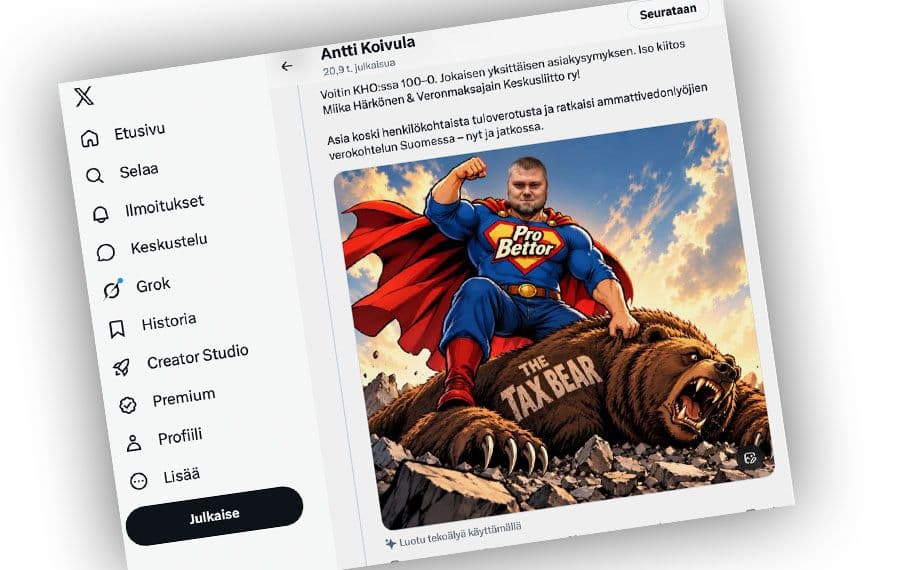
- The Supreme Administrative Court (KHO) ruled on 1 October 2026 that Antti Koivula’s 2020 non‑EEA betting qualifies as income‑generating activity, allowing deduction of €365,606 in losing stakes.
- Koivula placed 2,145 bets in 2020, with total stakes of €365,606, returns of €406,713 and a net betting result of about €41,100.
- KHO overturned a prior tax reassessment that had increased Koivula’s taxable income by €112,369.48 and removed a €1,154.60 tax increase, ordering Verohallinto to pay €5,820 in legal costs.
- The deductibility of phone, internet, home office, travel and football match‑ticket expenses was returned to the tax adjustment board for further consideration.
The Supreme Administrative Court of Finland (Korkein hallinto-oikeus, KHO) ruled on 1 October 2026 that Antti Koivula’s betting activity constituted income-generating activity under the Income Tax Act for his 2020 taxation, allowing him to deduct stakes used in losing bets. The decision closes a more-than-five-year dispute in Koivula’s favour but leaves other expense items — including phone, internet and match-ticket costs — referred back to the Tax Adjustment Board for further review.
What the KHO decision determined about Antti Koivula’s 2020 taxes
KHO found that Koivula’s betting was carried out with the purpose of earning income and that its scale and systematic nature made it a form of tulonhankkimistoiminta (income-generating activity) under the Income Tax Act. The court’s reasoning focused on the extent, planning and persistence of his activity rather than treating results as dependent on chance alone.
The decision specifically allowed Koivula to deduct the full stakes he paid in non-EEA (non-ETA) betting for 2020 — a total of €365,606 — from his taxable earned income. Koivula placed 2,145 bets during the year; total returns were €406,713, producing a net betting result of approximately €41,100.
KHO overturned an earlier tax adjustment that had treated only stakes on winning bets as deductible. That prior interpretation by the Finnish Tax Administration (Verohallinto) had excluded losing stakes, which had inflated Koivula’s reported taxable income relative to his actual net betting result.
Financial consequences and fees in the dispute
Because KHO sided with Koivula, the court rescinded the earlier tax reassessment and removed a €1,154.60 tax increase that had been applied. Verohallinto was ordered to reimburse Koivula’s legal costs, amounting to €5,820.
Earlier in the process, Verohallinto had increased Koivula’s taxable earned income by €112,369.48 and levied an additional €1,154.60 in tax penalties. Koivula says he has already paid slightly over €12,000 on his realised betting profit of just over €41,000. After the tax adjustment stage he faced a further potential tax claim of about €57,000, which accumulated interest over several years and, by his estimate, had swelled to roughly €75,000 (he described that figure as directional rather than exact).
Which expense items remain undecided
Not all of Koivula’s deductions were resolved by the KHO ruling. The court returned questions on the deductibility of costs related to a home office, phone, internet, office expenses, publications, business travel and football match tickets to the tax adjustment body for further consideration. Those items will be examined under the existing administrative-review process rather than by the Supreme Administrative Court in this decision.
Background on Koivula’s activity and the court’s reasoning
Koivula is a gambling law specialist and former professional bettor who now serves as head of compliance at Hippos ATG Oy. He told media outlets and industry programmes that between 2010 and 2020 he supported his household through professional betting. During the busiest periods he said he spent 50–100 hours a week on betting and 30–50 hours in quieter intervals, focusing mainly on Finnish football where he sought pricing errors in bookmakers’ odds through research and analysis.
Although KHO did not categorise the betting as trade or business activity (elinkeinotoiminta), the court concluded the results were not merely down to chance. The organised, planned and persistent nature of the work satisfied the criteria for income-generating activity; that legal classification enabled the deduction of stakes used in losing bets for the non-EEA wagers at issue.
The ruling did not set numerical thresholds for hours worked or stake sizes that would define professional betting in other cases. KHO emphasised assessment of the overall facts — systematic approach, longevity and purpose of earning income — rather than creating a fixed rule about hours or amounts.
Personal and sector implications quoted by Koivula
Koivula described the early phase of the dispute as financially serious: in spring 2022 the authorities had estimated taxable income at around €350,000, which by his calculation would have produced an approximately €166,000 tax bill. The prospect of that additional liability, plus years of accumulated interest, was a material personal strain; he told Nettipokeri.com that he was not wealthy and had three small children to support.
He also reflected publicly on the potential wider effect for other Finnish professional bettors, saying the decision may give a stronger basis for reviewing past tax assessments for those who conducted betting professionally and systematically.
"En ole miljonääri enkä taloudellisesti riippumattomassa tilanteessa. Minulla on kolme pientä lasta ja elätän perhettäni," Koivula told Nettipokeri.com, describing the personal pressure the case imposed.
On a different programme, Koivula speculated about the motives behind aggressive tax approaches and the broader risks they might present for players and professionals.
"Olen leikitellyt ajatuksella, että onko verohallinnon ajatuksena että saadaan toista sataa tuhatta oikeuskeissiä ja että laitetaan peliongelmaiset ja ammattipelaajat istumaan vankilaan," he said on AtleettiTV’s Vedonlyöntistudio.
Wider context: regulation, licensing and consumer protection
Koivula commented on the new gambling law and the importance of improved consumer protections for players. He contrasted customer service standards at some Malta-, Curaçao- and Costa Rica-based operators with those of licensed markets and warned that affiliate and influencer marketing is a sizable commercial activity that may migrate to offshore channels if domestic regulation tightens. The regulatory context makes the tax classification question relevant to broader policy debates on licensing and consumer safeguards.
For operators, regulators and tax professionals the ruling clarifies that systematic, long-term betting carried out to produce income can be treated as income-generating activity for tax purposes in Finland, with the effect that stakes may be deductible — at least for the non-EEA betting at issue in this case.
If readers want further details on legal developments tied to gambling regulation, see the coverage in our regulation section.
Frequently Asked Questions
What did the KHO rule in Antti Koivula’s tax case on 1 October 2026?
KHO ruled that Koivula’s 2020 betting activity constituted income‑generating activity under the Income Tax Act and allowed deduction of stakes used in non‑EEA losing bets amounting to €365,606. The court overturned an earlier reassessment and returned certain other expense questions to the tax adjustment board.
How many bets and what financial totals did Koivula report for 2020?
Koivula reported 2,145 bets in 2020 with total stakes of €365,606 and total returns of €406,713, producing a net result of approximately €41,100.
What did the Finnish Tax Administration previously decide and what were the consequences?
Verohallinto previously accepted only stakes on winning bets as deductible and increased Koivula’s taxable income by €112,369.48, plus a €1,154.60 tax increase; those measures were rescinded after the KHO ruling and Verohallinto was ordered to reimburse €5,820 in legal costs.
Which expense claims remain unresolved after the KHO decision?
The KHO decision left unresolved the deductibility of expenses related to a home office, phone, internet, office costs, publications, business travel and football match tickets, returning those items to the tax adjustment board for further review.
Tags
About the author

Oliver Grant
Industry Technology Correspondent
Oliver Grant covers the technology and business machinery of iGaming — platform and data deals, AI and compliance tooling, affiliate and marketing shifts, and the quarterly numbers behind them. The reports lead with the announcement, name the vendors and figures exactly as published, and separate genuine capability from press-release promise. When a supplier ships a new engine or a regulator tightens ad rules, Oliver Grant explains what actually changes for the companies involved.
More from Oliver Grant