German betting shops market shrinks as online betting dominates
Online accounted for about 74% of regulated stakes in 2025; roughly 2,300 shops remained.
Key Takeaways
- Regulated stakes in Germany were approximately €8.3bn in 2025, with €6.09bn online and €2.17bn in retail.
- Online share represented roughly 74% in 2025 and rose to about 76% in H1 2026.
- Estimates place around 2,300 betting shops in 2025, down from about 2,700 in 2023 and far below the 4,000–5,000 range in 2016.
- In 2025 the sector returned about €6.4bn in prizes and paid roughly €420m in sports-betting taxes.
The German market for betting shops has ceased to be an automatic-growth business: customers are shifting to the digital channel and the physical network has contracted markedly over the past decade. Official and industry data show regulated turnover rose from approximately €4.8bn in 2015 to €9.4bn in 2021, stabilising at €8.3bn in 2025, while in-person betting generated around €2.17bn of bets in 2025 versus €6.09bn online.
Stake development and channel split
In 2015 the German sports betting market reported roughly €4.8bn in fiscally declared stakes. By 2019 that figure rose to about €9.3bn, and in 2021 it reached approximately €9.4bn despite the pandemic. Subsequent years showed less spectacular numbers: €7.9bn in stakes in 2023, €8.2bn in 2024 and €8.3bn in 2025.
According to the market monitor of the Glücksspielbehörde der Länder (GGL), the 2025 split by channel was €2.17bn in retail stakes versus €6.09bn online, equivalent to roughly 74% of regulated volume on digital channels. First-half 2026 figures increase that online share to about 76%.
Shop network: from boom to contraction
A 2016 report by the state gambling authorities estimated between 4.000 and 5.000 private points of acceptance, including dedicated outlets and terminals in kiosks, bars and other venues. A 2023 presentation by pferdewetten.de estimated roughly 2.700 dedicated retail shops and the German Sports Betting Association (DSWV) reported about 2.300 shops in 2025, implying a reduction of around 15% between those two estimates.
Those figures do not specify exactly how many openings or closures were permanent, because definitions and methodologies have varied; they nonetheless indicate a clear trend toward a smaller physical distribution. The DSWV also reports that the roughly 2.300 shops supported about 6.700 jobs in 2025.
Profitability, costs and risks for franchisees
A total market of €8.3bn in stakes in 2025 does not translate into profits for operators or franchisees. The DSWV notes that in 2025 roughly €6.4bn was returned in prizes, about €420m was paid in sports-betting taxes, and the sector declared roughly €136m in advertising and €47m in sponsorship.
For a franchisee, fixed costs such as rent, staff and equipment can markedly raise the break-even point. The central operator typically controls product, technology and commercial terms; the local partner assumes many fixed costs. Changes to the platform, the operator licence or the commission structure can leave a franchisee with a shop that is hard to make profitable.
Regulation and venue authorisations
The Glücksspielstaatsvertrag 2021 reformed Germany’s regulatory framework: licensing requirements, responsible-gaming measures, exclusion systems and formal supervision became central to legitimate operations. State authorities retain venue-specific requirements, such as location restrictions and minimum distances to schools or other gambling establishments.
The GGL reminds stakeholders that an operator licence does not replace the local permits required for a physical establishment. Opening a venue can involve negotiating a lease and investing in fit-out without guaranteeing the necessary administrative approval.
Competition between networks and the Bet3000 case
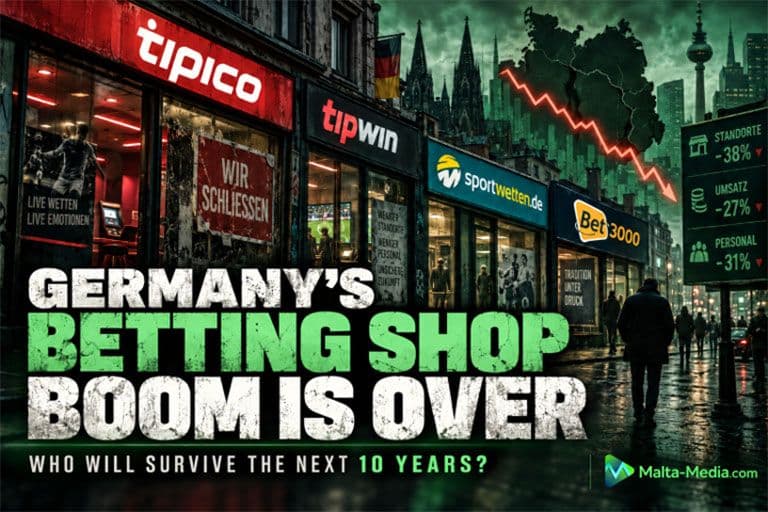
The German retail market has been dominated by recognisable brands: Tipico, Tipwin, Bet3000 and sportwetten.de. A 2024 presentation by pferdewetten.de estimated roughly 1.150 Tipico outlets, 292 Tipwin and 252 Bet3000 locations, numbers that illustrate scale differences though they do not constitute an official census.
Bet3000 exemplifies the dialectic fragility between brand and operational continuity. In July 2024 the German authority revoked the sports-betting permission of IBA Entertainment Limited, the previous operator linked to Bet3000; the company challenged the decision in court. In 2025 cooperation plans between Bet3000 and pferdewetten.de were revised and the GGL white list now identifies I.B.C. Sportsbetting Limited as the licence holder for bet3000.de.
Lower availability of new authorisations and fewer venues make already-licensed sites attractive to operators that prefer to acquire and convert existing points rather than open new ones.
Conclusion: fewer outlets, greater selectivity
Betting shops in Germany will not disappear entirely, but the market that enabled massive expansion has changed. The growing weight of the online channel, regulatory demands and pressure on shop economics mean the coming decade will favour operators that manage financially healthy networks and venues with sustainable returns. For anyone assessing a franchise, demanding real operating figures, transparency on commissions and clarity about scenarios of licence loss or platform change is an indispensable requirement. For background on regulatory changes see [regulation](/regulation) and for franchise matters consult our [b2b](/b2b) coverage.
“The question is no longer how much you can win, but how much you can lose,” writes Gonzalo Marín as the sector operations correspondent.
Frequently Asked Questions
How many betting shops were there in Germany in 2025?
There were about 2,300 betting shops in 2025 according to the German Sports Betting Association (DSWV). That compares with an estimated 2,700 dedicated shops in 2023 and a broader 4,000–5,000 points-of-acceptance range in 2016.
What share of regulated stakes took place online in 2025?
Approximately 74% of regulated sports-betting stakes were placed online in 2025, with €6.09bn online versus €2.17bn retail; the digital share rose to around 76% in the first half of 2026.
How did regulation affect the business of physical shops in Germany?
The Glücksspielstaatsvertrag 2021 introduced licensing requirements, responsible-gaming measures and formal supervision that increased operational complexity; state authorities also impose venue-specific conditions that can prevent approval of locations previously considered attractive.
What do the headline market figures tell us about operator profits?
In 2025 the regulated sector reported €8.3bn in stakes but returned about €6.4bn in prizes, paid roughly €420m in taxes, and declared around €136m in advertising and €47m in sponsorship, illustrating that gross stakes do not equal net profit for operators.
Tags
About the author

Gonzalo Marín
Industry Deals Correspondent
Gonzalo Marín covers the corporate deal flow of gambling — operator strategy, M&A, regulated-market entries, and product launches. The reports open with the transaction, cite companies, valuations, and jurisdictions exactly as released, and keep the announcement apart from its actual effect. When a Latin American operator raises capital or a European brand lands in the region, Gonzalo Marín reports who signs, for how much, and on what terms.
More from Gonzalo Marín