Polymarket Launches 15-Minute Bitcoin Contracts on US Platform
Short markets started trading on September 22, using the CF Benchmarks index.
Key Takeaways
- Polymarket launched up-or-down Bitcoin contracts with a 15-minute resolution on its US platform; they have been operational since September 22, 2026.
- Polymarket US uses the CF Benchmarks Bitcoin Real-Time Index to set opening and closing levels for each contract.
- A NEXTPredict test bought $2 in “Up”, received $26.84 when the contract resolved, and gained a net profit of $24.84.
- Kalshi records high volumes in 15-minute contracts, including nearly $2.5m in a September 8 window.
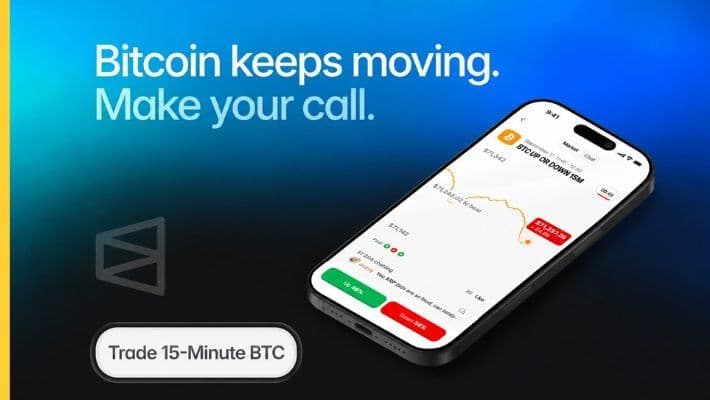
Polymarket launched up-or-down Bitcoin contracts with a resolution every 15 minutes on its US platform; the contracts became available for trading starting September 22, 2026, and the company promoted it in an email and on its main X account on September 28. The mechanism uses the CF Benchmarks Bitcoin Real-Time Index to set the reference level at the opening and closing points.
How 15-Minute Bitcoin Contracts Work
The new contracts allow bettors to wager on whether Bitcoin will finish a 15-minute window above or below its opening price. Market prices and probabilities are continuously updated until the contract closes. Polymarket US takes the opening and closing values from the CF Benchmarks Bitcoin Real-Time Index, which calculates an average of price readings around each endpoint.
We tested the product: NEXTPredict.io bought $2 in the “Up” option with about five minutes left in the window. At that moment, the market showed “Up” at 7%, with an estimated payout of approximately $26.85 if Bitcoin finished above the opening level. Bitcoin ended higher; the contract paid $26.84, and the net profit was $24.84. The payout was credited to the user when the contract resolved, about ten minutes after the trading window closed.
Polymarket US and the Regulatory Framework
The introduction of the 15-minute contracts did not result from new approval from the Commodity Futures Trading Commission (CFTC) during the launch week. Polymarket US paved the regulatory path months prior: on March 26, it submitted an amendment to the CFTC expanding its Cryptocurrency Price Contracts and included the concrete example, “Will Bitcoin go up in the next 15 minutes?”. In August, the platform continued certifying crypto products—Polymarket US self-certified price contracts for Bitcoin, Ether, and Solana—and all three were listed as certified on August 26.
The CFTC's self-certification process allows designated markets to list products after certifying that they comply with federal commodities law, without waiting for specific approval for each market.
Competition in Short-Duration Crypto Markets and Benchmark Figures
Polymarket enters a segment where Kalshi already records substantial volumes. Kalshi offers 15-minute up/down markets for Bitcoin, Ether, XRP, Solana, Dogecoin, and BNB; Bitcoin is the largest market within that category. Individual 15-minute contracts on Kalshi have reached seven-figure volumes over specific windows, including around $2.5m during a window on September 8.
Gemini Predictions also offers five- and 15-minute crypto contracts, in addition to longer durations, and has expanded the format to assets like Ether, XRP, and Solana. Other US markets and brokers have introduced short-duration crypto contracts.
How They Are Traded and User Experience
In practice, a 15-minute contract behaves like a continuous flow of opportunities: when one window ends, another begins immediately. During the life of the contract, the price moves with the Bitcoin quotation against the benchmark level, and traders can add positions or sell before the closing.
The experience documented by NEXTPredict showed the market's rapid movement: the Bitcoin quotation fluctuated against the benchmark level, and the contract price varied in real-time, forcing agile decisions. The contract resolved, and the payout arrived in the user's balance shortly after the closing, following a verification of the benchmark index.
Risks, Microbetting, and Regulatory Precedents
The rapid resolution format and immediate succession of contracts evoke parallels with microbetting in sports, a discipline that has drawn attention from responsible gambling advocates. Studies related to microbetting have linked the format to greater severity of gambling problems and impulsivity, citing the short interval between placing a bet and knowing its outcome as a significant factor.
The issue was raised in public debate during a hearing on September 15 in the Texas Senate State Affairs committee, where gambling policy expert Brianne Doura-Schawohl described sports microbetting as high-risk. Robert DeNault, head of compliance at Kalshi, noted in that session that Kalshi does not offer next-action contracts in sports.
Although the 15-minute crypto contracts are not sports microbets in the strict sense, they share relevant structural traits: a brief period between entry and resolution, continuously changing prices, and the immediacy of the next market opportunity.
Implications for Operators, Traders, and Regulators
For market operators and technology providers, the format puts pressure on matching and orchestration engines to resolve and issue contracts with very low operational latency. Traders require low-friction access and capabilities to react in real-time. Regulators and policymakers will need to consider how consumer protection rules apply to extremely fast-resolution crypto products.
As of now, Polymarket US shows only Bitcoin contracts on its crypto page according to verification conducted on Monday afternoon; the company announced the new format in its public communication on September 28 and in emails sent to users.
"Bitcoin up or down? 15-minute crypto up/downs are now live in the Polymarket US app. Let the bull season begin," Polymarket tweeted from its main account on September 28.
Polymarket adds another iteration to its international offering, where its global platform already includes crypto contracts with durations ranging from five minutes to daily contracts covering Bitcoin, Ether, Solana, XRP, Dogecoin, and BNB.
What Market Participants Should Watch For
Liquidity per window: Kalshi's experience suggests that some windows may reach seven figures in volume, with specific spikes (e.g., around $2.5m during a September 8 window).
Price reference: Polymarket US uses the CF Benchmarks Bitcoin Real-Time Index for opening and closing.
Resolution and Timing: Payment can be credited minutes after closing; in the cited test, the payout was reflected about ten minutes after the window ended.
The inclusion of 15-minute contracts in Polymarket US confirms that the strategy for short-duration crypto products continues to expand in regulated markets across the United States.
Frequently Asked Questions
When did 15-minute contracts start trading on Polymarket US?
The contracts became available for trading on September 22, 2026. Polymarket promoted the offering through an email and a tweet on September 28.
What benchmark does Polymarket use to determine the resolution of a 15-minute contract?
Polymarket US employs the CF Benchmarks Bitcoin Real-Time Index to set opening and closing levels, based on an average of price readings around each endpoint.
What result did the NEXTPredict test achieve with a 15-minute contract?
NEXTPredict purchased $2 in “Up” with five minutes left; the market showed 7%, and it paid $26.84 when Bitcoin closed above the starting level, generating a profit of $24.84.
Tags
About the author

Renata Quiroga
Betting Markets Correspondent
Renata Quiroga covers sports betting and prediction markets — sportsbook launches, odds technology, event contracts, and the regulatory calls that decide what can be bet on and where. The reports open with the product or the ruling, name operators and platforms precisely, and explain the mechanics without needless jargon. When a book enters a Latin American market or a prediction exchange lists a contested contract, Renata Quiroga reports what changes for the bettor.
More from Renata Quiroga