Romania accelerates shift to online betting after tax and local-authority reforms
Higher 2025 taxes and 2026 municipal authorisations reshape the gambling economy
Key Takeaways
- Law 141/2025 raised the online authorisation rate from 21% to 30% of GGR and increased the annual minimum fee to €480,000.
- Emergency Ordinance 7/2026 requires municipal authorisations for retail venues from February 2026, allowing local bans, zones and annual fees.
- H2 Gambling Capital projects the regulated market in H2 2026 at roughly 71% online and 29% land-based.
- The slot-machine fleet fell from about 80,000 to near 36,000 between 2024 and 2026, according to H2 Gambling Capital figures cited by AGERPRES.
The Government of Romania and the national regulator have introduced changes that raise costs and restrict the land-based gambling environment, accelerating the shift toward digital channels. Law 141/2025 increased taxes on GGR and modified minimum licensing fees; in February 2026 Emergency Ordinance 7/2026 imposed local authorisations for physical venues. By Miguel Sandoval, Corresponsal de regulación.
Gambling regulation in Romania and the new fiscal framework
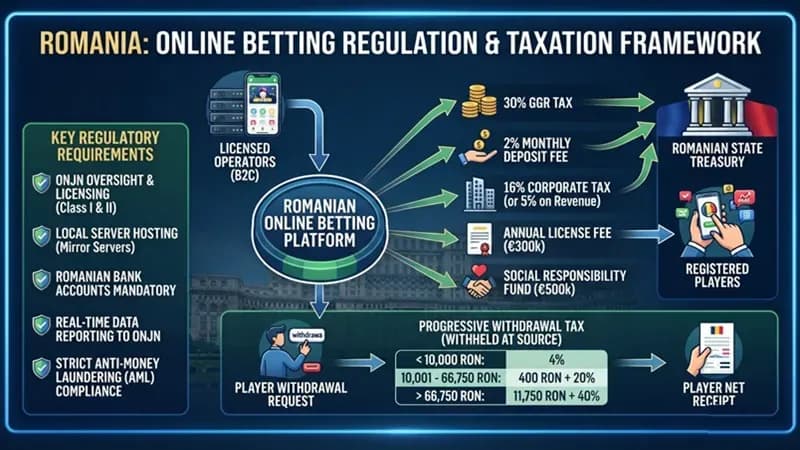
Law 141/2025 redesigned the tax burden for the gambling sector with clear effects on operating profitability. For online gambling the authorisation rate on Gross Gaming Revenue (GGR) rose from 21% to 30%, and the annual minimum authorisation fee increased from €400,000 to €480,000. For fixed-odds retail betting the levy rose from 21% to 25% of GGR and the annual minimum fee was raised from €200,000 to €240,000.
Tax changes also affected players. Since August 2025 withholding on winnings applies in three brackets: 4% up to RON 10.000; RON 400 plus 20% on the excess between RON 10.000 and RON 66.750; and RON 11.750 plus 40% on the amount exceeding RON 66.750. For online gambling the withholding is applied when funds are transferred from the player’s gaming account to their bank account or an equivalent withdrawal method.
FDJ United, the operator of the Unibet brand in Romania, cited the Romanian tax increase among the factors affecting its 2026 financial performance, reporting an accumulated impact of almost €24 million in its first half of 2026 from tax rises in several markets, including Romania.
How municipal authorisation is reconfiguring land-based venues
Emergency Ordinance 7/2026 changed the relationship between the national licence and local access. From February 2026 local administrations may:
decide whether to permit gambling activities in their territory;
determine the specific zones where venues may be located;
set an annual local authorisation fee based on the size of the venue.
Before 2026 a national licence with operational authorisation allowed activity throughout the country within the legal framework. With the reform, operators with physical networks must manage municipal authorisations in addition to the national licence issued by the National Office for Gambling (Oficiul Național pentru Jocuri de Noroc, ONJN). The change fragments market access and forces a re-evaluation of capital allocation to the retail network.
The effects are already visible in the machine fleet: figures cited by AGERPRES, based on H2 Gambling Capital, show a fall from approximately 80.000 slot machines two years ago to about 36.000 in 2026. The same analysis estimates around 1.310 operating gaming halls with some 69 licence holders.
The structural shift to the digital channel and its implications
H2 Gambling Capital, quoted by AGERPRES, placed land-based share at around 48% of the regulated market in 2023 versus 52% online. Its projections for H2 2026 put that balance at about 29% retail and 71% online.
2025 corporate results illustrate the commercial scale: Superbet Entertainment reported revenue of RON 4.58 billion (≈€859.73 million); Kaizen Gaming International (Betano) recorded RON 865 million (≈€161.63 million); and Unibet’s Romanian operation reported RON 368.9 million (≈€68.93 million). These figures come from local financial filings and should be interpreted cautiously because of the presence of branches and permanent establishments within corporate groups.
The move online increases the importance of mobile product, digital acquisition, CRM, payments and platform technology. For operators, higher tax and cost pressure means that scale and operational efficiency are decisive to preserve margins.
Advertising restrictions and marketing consequences
The new Audiovisual Content Regulatory Code, effective since August 2025, prohibits gambling advertising that features public figures from cultural, scientific or sporting fields, as well as online personalities with notoriety who might encourage participation. The Consiliul Național al Audiovizualului (National Audiovisual Council, CNA) has overseen and sanctioned breaches of this rule.
Article 109 of the Code bans gambling programmes and advertising between 06:00 and 23:00, except for betting ads during live sports broadcasts. The limits reduce the viability of celebrity campaigns and increase operators’ incentive to develop direct relationships via owned channels, CRM and loyalty programmes. These measures also affect the affiliate ecosystem and the promotion of unlicensed operators, which the legislation penalises with fines and confiscations.
The illegal market and the regulatory response
The reforms aim to increase control over gambling activity and its social impact, but raise a classic tension: higher taxes and costs can push some demand toward unregulated alternatives. The national authority, the National Office for Gambling (ONJN), retains licence and compliance supervision, while technological tools — payment controls, identity verification, player monitoring and responsible gaming systems — are cited as ways to distinguish legal supply from offshore activity.
What’s next for operators in Romania?
The Romanian market will tend to be more digital and technology-dependent. For online operators, priorities are investment in mobile product, payment experience, CRM, data and responsible gaming systems. Retail operators must focus on optimising networks, managing municipal authorisations and articulating tighter retail-to-digital integration.
The persistence of large corporate revenues indicates that Romania remains a commercially relevant market, but the challenge is to define which operating models are sustainable under the new regulatory economy. For companies and observers in Central and Eastern Europe, Romania’s evolution provides lessons on balancing regulatory control and the viability of a licensed market.
Frequently Asked Questions
What new taxes did Romania introduce for gambling in 2025?
Law 141/2025 increased the authorisation rate on online GGR from 21% to 30% and raised the annual minimum authorisation fee from €400,000 to €480,000; for retail betting the rate rose to 25% and the annual minimum fee to €240,000.
Since when do local authorities require authorisation for gambling premises?
Emergency Ordinance 7/2026, effective from February 2026, allows local councils to decide whether to permit gambling activities, to set authorised zones and to impose an annual local fee for premises.
How are player winnings taxed under the new rules?
From August 2025 winnings are withheld in three brackets: 4% up to RON 10,000; RON 400 plus 20% on the excess between RON 10,000 and RON 66,750; and RON 11,750 plus 40% on amounts above RON 66,750. For online play the withholding is applied at withdrawal to a bank account.
What operational impact do the new rules have on operators?
Higher taxes and local fragmentation increase the importance of digital scale: operators must prioritise mobile product, CRM, payments and operational efficiency, while retail businesses need to optimise their networks and manage municipal authorisations.
Tags
About the author

Miguel Sandoval
Regulatory Affairs Correspondent
Miguel Sandoval tracks gambling legislation, licensing, and regulator enforcement — from Spain's DGOJ and the Latin American authorities to the UKGC, the MGA, and the state-by-state map in North America. The reports answer three questions precisely — what changed, where, and who it affects — with jurisdictions, dates, and penalties cited exactly as published. Operators and compliance officers read Miguel Sandoval to know which rulebook moved before their next meeting.
More from Miguel Sandoval