Blask Releases World Cup 2026 iGaming Demand and Profitability Report
Blask's 2026 World Cup Report analyses iGaming demand shifts, national interest trajectories, and bookmaker profitability across 44 markets, highlighting minimal demand growth but major match-by-match swings.
Key Takeaways
- Blask's World Cup 2026 Report shows iGaming demand rose just 0.2% during the tournament.
- The US saw demand drop 28% post-elimination, while Canada saw a 7% increase.
- Bookmakers had net losses overall, with player profits overtaking operator margins.
- Blask introduced the Match Profitability Index to score each match on betting result.
- Brand-level performance varied sharply, with the leading operator up 464% in demand.
Blask, the AI-native iGaming market-intelligence provider, has published its World Cup 2026 Report, presenting granular data on betting demand, brand engagement, and bookmaker profitability across 44 regulated and grey markets. Despite the scale of the tournament, Blask’s findings confirm that overall iGaming demand barely budged against pre-tournament levels, and bookmaker margins suffered in aggregate as measured by Blask's new Match Profitability Index.
Core Findings of the Blask World Cup 2026 Report
Blask’s report draws on proprietary real-time, search-driven demand tracking. It directly compares:
- iGaming demand during World Cup 2026
- performance across the tournament run-up
- benchmarks from the equivalent calendar period in 2025
Three headline findings emerge:
- iGaming demand was largely flat. The Blask Index—a composite metric tracking market-level activity—rose just 0.2% relative to the pre-World Cup baseline.
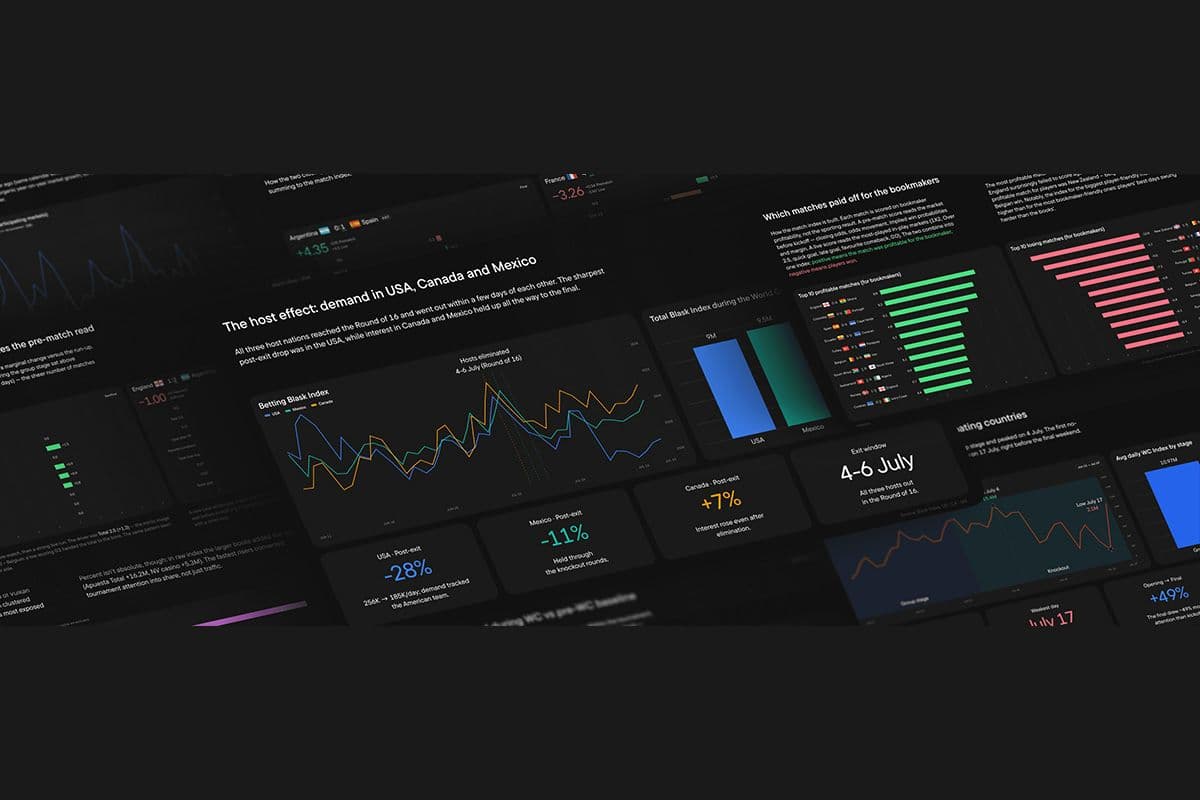
- Local interest proved fleeting after national eliminations. In the United States, demand declined 28% in the days following the home team’s exit. Mexico’s retreat was less severe at an 11% drop. Canada, by contrast, saw a 7% bump in demand post-elimination.
- New profitability data suggests punters outperformed bookmakers. The newly introduced Match Profitability Index, debuting in this report, scores outcomes based on betting profits rather than match results. Of all 104 tournament matches, bookmakers faced net losses in aggregate. The goalless draw between England and Ghana yielded the largest single-match profit for operators, while New Zealand’s 1-5 defeat to Belgium delivered the steepest bookmaker losses.
iGaming Demand and Market Reactions During World Cup 2026
The Blask Index's subdued 0.2% climb challenges the narrative that global football tournaments automatically boost gaming activity. This pattern was consistent across most of the 44 tracked markets. Site traffic, player registrations, and betting volume remained near their recent trajectories, suggesting mature markets did not see tournament-driven surges ( see b2b for live iGaming market analytics).
National team performance shaped spikes and troughs:
- US demand dropped dramatically after team elimination—down 28%.
- Mexico’s 11% dip emerged more gradually.
- Canada bucked the trend, with a 7% rise after leaving the competition.
Local operators and international sportsbook brands may need to reassess campaign timing and retention strategies for major events in North America.
Match Profitability Index: Bookmaker Performance and Standout Results
Blask's Match Profitability Index, included for the first time, gives a direct read on whether bookmakers or players netted more from each World Cup match. The analysis spans all 104 matches:
- Bookmakers finished the tournament net behind bettors overall.
- England’s 0-0 draw with Ghana generated the highest single-match operator profit.
- New Zealand’s 1-5 loss to Belgium was the costliest match for bookmakers.
This granular approach marks a notable advance for supplier analytics and may inform future risk-management models and promotional planning by major betting brands.
“The new Match Profitability Index allows us to objectively track every result—good or bad—for the house,” a Blask analyst commented in the report’s preface.
Timing of Demand Peaks and Brand-Level Performance
Analysis of the Index by geography found that, in most markets, search interest peaked in the opening week of World Cup 2026, with demand waning toward the final. This dynamic was tracked across both mature and emerging iGaming regions.
On the brand side, the report notes significant disparities:
- The top-trending betting brand saw a +464% swing in search-driven demand relative to its pre-tournament baseline.
- Several mid-tier brands experienced moderate uplifts, while others registered flat or even negative trends, underlining the competitive volatility around major sports events.
A full match-by-match profitability summary is included in Blask’s extended publication, offering deeper granularity for suppliers and operators focused on market positioning and risk exposure.
Industry Implications of the 2026 World Cup Report
For sportsbook operators, platform vendors, and market analysts, the Blask World Cup 2026 Report provides actionable evidence that tournament effects are heterogeneous and often unpredictable. Flat demand growth, short-lived national momentum, and overall bookmaker losses suggest a need for refined targeting and more dynamic risk management—especially in regions where football viewership alone may not guarantee sustained engagement.
Stakeholders may wish to further consult news and sports for real-time updates and market reactions to future events drawing similar scale and interest.
Frequently Asked Questions
What is Blask's World Cup 2026 Report?
Blask's World Cup 2026 Report is a data-driven analysis covering betting demand, national market swings, and bookmaker profitability across 44 global markets using real-time demand tracking.
How did iGaming demand change during World Cup 2026?
iGaming demand was nearly flat, with the Blask Index reporting only a 0.2% increase compared to pre-tournament activity across tracked markets.
What is the Match Profitability Index introduced by Blask?
The Match Profitability Index is a new metric that scores matches on whether bookmakers or bettors profit. For World Cup 2026, bookmakers were net losers in aggregate.
Which markets saw the biggest change in iGaming interest after their team exited?
US demand dropped 28% after elimination, Mexico 11%, and Canada registered a 7% rise in activity according to Blask's data.
Which match was most profitable for bookmakers at World Cup 2026?
England vs Ghana (0-0) provided the largest single-match profit for bookmakers during the tournament, while New Zealand’s 1-5 loss to Belgium was the most loss-making.
Tags
About the author

Marcus Webb
Industry Deals Correspondent
Marcus Webb covers the deal flow of the gambling industry — operator strategy, M&A, market entries, and product launches from sportsbook rebrands to full platform migrations. The reports name the companies, valuations, and jurisdictions exactly as disclosed and separate the announcement from its market impact. When a group consolidates a brand or a challenger launches into a new state, Marcus Webb explains who gains, who pays, and what closes next quarter.
More from Marcus Webb