Gambling Commission unveils Illegal Gambling Index using seven behavioural indicators
Index draws on Gambling Survey for Great Britain and found 1% engagement with illegal sites over 12 months
Key Takeaways
- The Gambling Commission launched an Illegal Gambling Index built from seven self-reported behavioural indicators.
- First-year Gambling Survey for Great Britain data found 1 per cent engagement with illegal gambling websites over the previous 12 months.
- Among people who gambled online in the previous year, 4 per cent showed engagement with illegal sites; 128 respondents were classified as illegal-site users.
- The Commission will add survey questions in 2027 to better understand four illegal-user personas and intends to refine the Index over time.
The Gambling Commission has launched an Illegal Gambling Index that combines seven self-reported behavioural indicators to measure consumer engagement with unlicensed gambling websites. The Commission published first-year data from the Gambling Survey for Great Britain showing that 1 per cent of respondents demonstrated engagement with illegal gambling websites during the previous 12 months, and that the figure rises to 4 per cent among people who gambled online.
What the Illegal Gambling Index is and how it was built
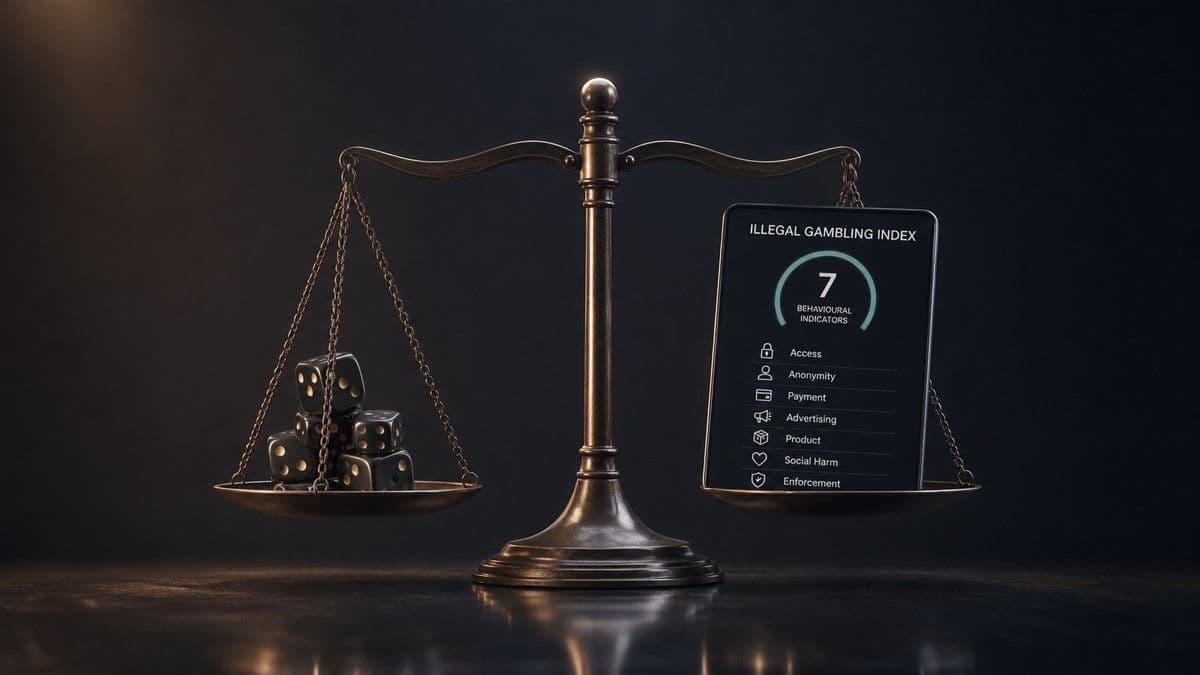
The Illegal Gambling Index uses seven behaviours associated with a higher likelihood of using unlicensed operators. The indicators include gambling on sites not registered with Gamstop, opening accounts without age or identity verification checks, cancelling withdrawals before funds are paid out, and using virtual private networks (VPNs) to access gambling services unavailable in Great Britain. The framework was developed through a multi-phase research programme comprising consumer surveys, interviews, focus groups, expert input and advice from specialist Commission panels.
Research and Impact Manager Rupam Jagota, writing on the Gambling Commission blog, said the index was designed because directly asking consumers whether they had used illegal sites produced unreliable results. He wrote that consumer engagement with illegal gambling is often hidden, driven by multiple factors, and sometimes unintentional, which makes it difficult to capture through traditional survey questions. The index aims to identify engagement through behavioural signals rather than relying on a single self-declaration. Jagota also said:
"Understanding the consumer characteristics of illegal online gambling has been no easy task. By its nature, consumer engagement is hidden, driven by a complex number of factors, and sometimes unintentional, which makes it difficult to measure through traditional survey methods." — Rupam Jagota, Gambling Commission
Jagota added that the tool is intended to evolve: "The Illegal Gambling Index has therefore been designed to be an adaptable measure, as we learn more about the illegal gambling market, we can refine and update the Index to ensure that it provides a current and reliable measure of consumer engagement with illegal gambling websites."
Survey findings and sample details
The Gambling Survey for Great Britain supplied the data used in the first-year analysis. The estimates are based on four quarterly waves conducted between April 2025 and April 2026 and include 14,257 respondents, of whom 3,569 had gambled online during the previous year. From that sample, 128 respondents were classified as illegal gambling users.
Breakdowns published by the Commission include:
1 per cent of all respondents showed engagement with an illegal gambling website in the previous 12 months.
4 per cent of people who gambled online in the previous 12 months showed engagement with illegal gambling websites.
About 2.5 per cent of adults who had gambled online in the previous year used an illegal gambling website in the four weeks before being surveyed.
A further 1.5 per cent reported using one at some point in the previous 12 months but not during the preceding four-week period.
Across the wider adult population, including non-gamblers, comparable figures were 0.6 per cent and 0.4 per cent respectively for the four-week and earlier 12-month windows.
The Commission reported that 94.4 per cent of respondents showed no indicators of using an illegal gambling website, while 4.6 per cent displayed some signs associated with illegal gambling but lacked sufficient evidence to be classified as users.
Behavioural profile of those classified as illegal-site users
Among the 128 respondents classified as illegal gambling users, the Commission reported several prominent behaviours:
58 per cent said they had knowingly used a website that was not registered with Gamstop.
56.6 per cent reported cancelling a withdrawal before funds reached a bank account or digital wallet; licensed operators in Great Britain have been prohibited from allowing customers to reverse withdrawals since 2021.
Nearly 47 per cent said they had joined a gambling website because they knew it would not require age or identity verification checks.
The Commission acknowledged concern about small numbers in the illegal-user subsample but framed the index and survey as tools to improve understanding of a group that may face elevated risks.
Sue Young, the Gambling Commission’s executive director for operations, said the analysis would help regulators better understand a segment of consumers who may experience higher harm:
"While engagement with the illegal market from an overall population perspective appears low and stable from these indicators, there is a cohort of online gamblers who use these sites and research suggests those consumers who use illegal operators are more likely to experience harm." — Sue Young, Gambling Commission
Next research steps and policy context
The Commission plans to add new survey questions in 2027 to improve understanding of four user personas it previously identified: Self-Excluders, Skilled Advocates, Social Explorers and Accidental Tourists. The supplementary questions are intended to refine how the Index differentiates between types of illegal gambling consumers.
The Commission said it will continue to use the Index alongside the Gambling Survey for Great Britain to track trends in the illegal market and to inform regulatory and consumer protection work. The regulator also said it will continue working with government bodies, gambling operators, technology providers and financial institutions to disrupt illegal activity. The UK government has already established an illegal gambling taskforce focused on unlicensed online operators and the payment and advertising systems that support them. The Commission framed the Index as a measurable, adaptable approach to monitoring an area that is difficult to observe directly.
Data, limitations and transparency
The Commission set out the methodological basis for the Index and the underlying survey waves, making clear that a small number of identified illegal-site users (128) limits the precision of some subgroup estimates. The regulator emphasised that the Index is intended to be refined as further data and qualitative insight become available.
The Gambling Commission said it will publish further analysis as the research programme progresses and as the Index is updated to reflect changes in consumer behaviour or illegal-market tactics. The Commission also noted it would use the Index alongside other tools and partnership activity to target disruption of illegal online gambling.
Frequently Asked Questions
What is the Gambling Commission's Illegal Gambling Index?
The Illegal Gambling Index is a measurement tool that combines seven behavioural indicators associated with unlicensed gambling activity. It uses self-reported behaviours such as using sites not registered with Gamstop, creating accounts without identity checks, cancelling withdrawals before payout and using VPNs, and was developed through a multi-phase research programme including surveys, interviews and expert panels.
How many people in Great Britain use illegal gambling websites according to the survey?
First-year data from the Gambling Survey for Great Britain showed that 1 per cent of respondents demonstrated engagement with illegal gambling websites in the previous 12 months. Among people who had gambled online during that period the figure rose to 4 per cent.
What sample underpins the Commission's estimates?
The estimates are based on four quarterly waves of the Gambling Survey for Great Britain conducted between April 2025 and April 2026, including 14,257 respondents, of whom 3,569 had gambled online in the previous year; 128 respondents were classified as illegal gambling users.
What further research will the Commission conduct in 2027?
The Commission plans to introduce supplementary survey questions in 2027 to better understand different types of illegal gambling consumers, targeting four previously identified personas: Self-Excluders, Skilled Advocates, Social Explorers and Accidental Tourists.
Tags
About the author

Eleanor Whitfield
Regulatory Affairs Correspondent
Eleanor Whitfield tracks gambling legislation, licensing decisions, and regulator enforcement across key markets — from the UKGC, MGA, and Germany's GGL to Spain's DGOJ and the state-by-state map in the Americas. The reporting answers three questions precisely: what changed, where, and who it affects, with jurisdictions, effective dates, and penalty figures named exactly as published. Compliance officers and operators read Eleanor Whitfield to know which rulebook moved before their next board meeting.
More from Eleanor Whitfield