Romania tightens gambling rules as market shifts decisively online
2025 tax rises and 2026 local licences push operators toward digital scale.
Key Takeaways
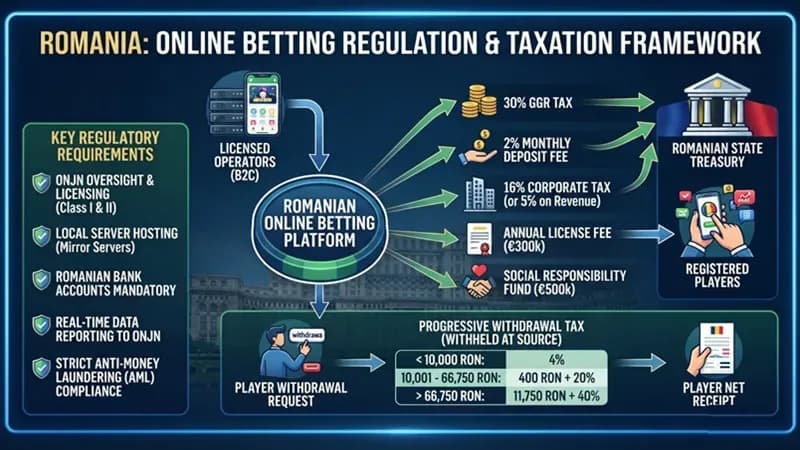
- Law 141/2025 raised the online authorization tax from 21% to 30% of GGR and increased the minimum annual fee to €480,000.
- Government Emergency Ordinance 7/2026 requires municipal operating authorisations for physical gambling venues.
- H2 Gambling Capital estimated the market could shift from roughly 52% online in 2023 to about 71% online by H2 2026.
- Player winnings taxation since August 2025 uses three tiers with rates up to 40% above RON 66,750.
The Romanian legislature raised gambling taxes in 2025 and then introduced municipal-level approvals for physical venues in 2026, reshaping operator economics and accelerating a shift to online betting. Law 141/2025 increased GGR-based authorization taxes and set higher minimum annual fees; Government Emergency Ordinance 7/2026 created local operating authorisations for land-based sites and allowed councils to ban or limit physical gambling within their territory.
Romania gambling regulation tightens after 2025 tax changes
Law 141/2025 reworked the tax burden for licensed gambling in Romania. For online gambling the authorization tax rose from 21% to 30% of gross gaming revenue (GGR), and the minimum annual authorization tax increased from €400,000 to €480,000. For land-based fixed-odds betting the rate moved from 21% to 25% of GGR, with the minimum annual authorization tax rising from €200,000 to €240,000.
The law also changed how winnings are taxed for players from August 2025. Withholding tax on prizes was set at three tiers: 4% for winnings up to RON 10,000; RON 400 plus 20% on the amount above RON 10,000 for prizes up to RON 66,750; and RON 11,750 plus 40% on amounts exceeding RON 66,750. For online play, the tax is withheld when funds move from a player's gaming account to a bank account or similar withdrawal method.
FDJ UNITED, which operates Unibet in Romania, has attributed part of its weaker first-half 2026 results to gaming tax increases across multiple markets, including Romania, saying the cumulative effects cost almost €24 million in H1 2026.
How higher taxation changes operator economics and scale
Higher GGR taxation reduces the pool available for marketing, technology, payment fees, bonuses and staff. That creates stronger incentives for operators to pursue digital scale, since larger online volumes spread fixed costs and tax impact across more bets.
Romanian company filings for 2025 show Superbet Entertainment reporting turnover of RON 4.58 billion (€859.73 million), Kaizen Gaming International (the Betano operator) reporting RON 865 million (€161.63 million), and Unibet’s Romanian operation reporting RON 368.9 million (€68.93 million). These figures reflect company-level reporting structures and should be treated as indicators of scale rather than definitive market-share rankings.
Platform, payments and CRM capabilities are now central to competitiveness. Operators that can lower acquisition costs, improve retention and optimise payments are better placed to absorb the higher tax bite. Suppliers and vendors that offer product, mobile experience, CRM, payments, data and responsible gambling tools will see demand from operators seeking to protect margins.
Local authorisations for land-based venues reshape retail strategy
Government Emergency Ordinance 7/2026 amended the national framework by introducing local operating authorization for physical gambling premises. Local councils can decide whether gambling is permitted in their administrative area, designate permitted zones and fix an annual local authorization fee tied to the premises’ size.
That change fragments market access. Previously a national licence granted the basis for activity across Romania, subject to national rules; now physical operators must secure municipal permission as well. H2 Gambling Capital data cited by AGERPRES show approximately 80,000 slot machines two years ago compared with about 36,000 in 2026, and an estimated 1,310 gaming halls operated by roughly 69 licence holders remain open. These figures indicate a substantial contraction in the physical footprint.
Operators face a strategic choice: consolidate retail estates, downsize the number of venues, or shift capital and management focus to digital channels that are not subject to municipal zoning. That decision depends on each business’s balance of retail revenue, brand reach and digital capability.
Advertising and content rules narrow marketing options
Romania’s new Audiovisual Content Regulatory Code took effect in August 2025 and banned gambling advertising that features public, cultural, scientific or sports personalities or people whose online notoriety could encourage gambling. The National Audiovisual Council (CNA) has monitored broadcasts and sanctioned violations of the rule.
Article 109 of the Audiovisual Code also restricts when gambling advertising and gambling programmes may air: prohibited between 06:00 and 23:00, with an exception allowing betting advertisements during live sports broadcasts. Those constraints reduce the effectiveness of celebrity-led campaigns and increase the value of direct digital marketing, CRM and owned channels. The limits also change how operators approach sponsorship and sports partnerships and have implications for affiliates and acquisition partners.
Market composition and the move to online betting
Central and Eastern Europe observers consider Romania one of the region’s more established regulated markets. The National Office for Gambling (ONJN) has overseen licensing and supervision since the framework established by Government Emergency Ordinance 77/2009. Online gambling has been licensable under Romanian law since 2015, attracting both domestic operators and international groups.
H2 Gambling Capital estimated that in 2023 land-based activity comprised around 48% of Romania’s regulated gambling market and online about 52%; by H2 2026 H2 estimated that balance could shift to roughly 29% land-based and 71% online. Traffic data published in February 2026 showed Superbet and Betano among the most visited operator domains in Romania.
The regulated market also includes Casa Pariurilor, eFortuna, Winbet, Mozzartbet, Stanleybet, NetBet and the state-owned Loteria Română.
Illegal market, enforcement and the role of technology
Regulatory tightening aims to improve control over gambling activity and its social impact, but higher taxes and operating costs raise the persistent question of displacement toward unlicensed alternatives. The outcome will depend on enforcement effectiveness and the visibility and consumer experience of licensed operators.
Technology and controls — payment monitoring, identity verification, player surveillance and responsible-gambling tools — are means for licensed operators and regulators to differentiate the legal market from offshore activity. Improved data collection and monitoring give the National Office for Gambling more tools to oversee compliance and to prioritise enforcement work.
What operators and suppliers should prioritise now
Operators with large retail networks must reassess capital allocation and municipal engagement strategies. Online operators should prioritise product development, mobile UX, payment integrations, CRM and compliance tooling. Vendors in payments, platform technology and responsible-gambling systems can expect increased demand as operators seek operational efficiencies and customer-level economics.
For investors and regional observers, Romania remains commercially significant but governed by a regulatory environment that now places a premium on scale, digital capability and local regulatory management. The next phase for the market will be defined by which operating models can sustain margins under the new tax and municipal-authorisation regime.
Frequently Asked Questions
What did Law 141/2025 change for online gambling taxes in Romania?
Law 141/2025 increased the online authorization tax from 21% to 30% of GGR and raised the minimum annual authorization tax from €400,000 to €480,000; the change also raised the tax rate for land-based fixed-odds betting to 25% of GGR with a minimum annual fee of €240,000.
When did local councils gain control over physical gambling authorisations?
Local councils acquired the power to permit, restrict or ban physical gambling and to set annual local authorisation fees under Government Emergency Ordinance 7/2026, which amended national gambling legislation in February 2026.
How are player gambling winnings taxed in Romania now?
From August 2025 winnings are taxed at three levels: 4% for prizes up to RON 10,000; RON 400 plus 20% on the excess up to RON 66,750; and RON 11,750 plus 40% on amounts above RON 66,750, with withholding applied on withdrawals from gaming accounts.
What evidence shows Romania is moving toward online betting?
H2 Gambling Capital estimated land-based share fell from about 48% in 2023 to an expected 29% by H2 2026, and operator filings show large online-focused turnovers such as Superbet Entertainment’s RON 4.58 billion in 2025.
Tags
About the author

Eleanor Whitfield
Regulatory Affairs Correspondent
Eleanor Whitfield tracks gambling legislation, licensing decisions, and regulator enforcement across key markets — from the UKGC, MGA, and Germany's GGL to Spain's DGOJ and the state-by-state map in the Americas. The reporting answers three questions precisely: what changed, where, and who it affects, with jurisdictions, effective dates, and penalty figures named exactly as published. Compliance officers and operators read Eleanor Whitfield to know which rulebook moved before their next board meeting.
More from Eleanor Whitfield