CFTC pushes swap definition as funding rises and bets increase on Brazil
Two CFTC rules, a federal ruling and large funding rounds shape the week
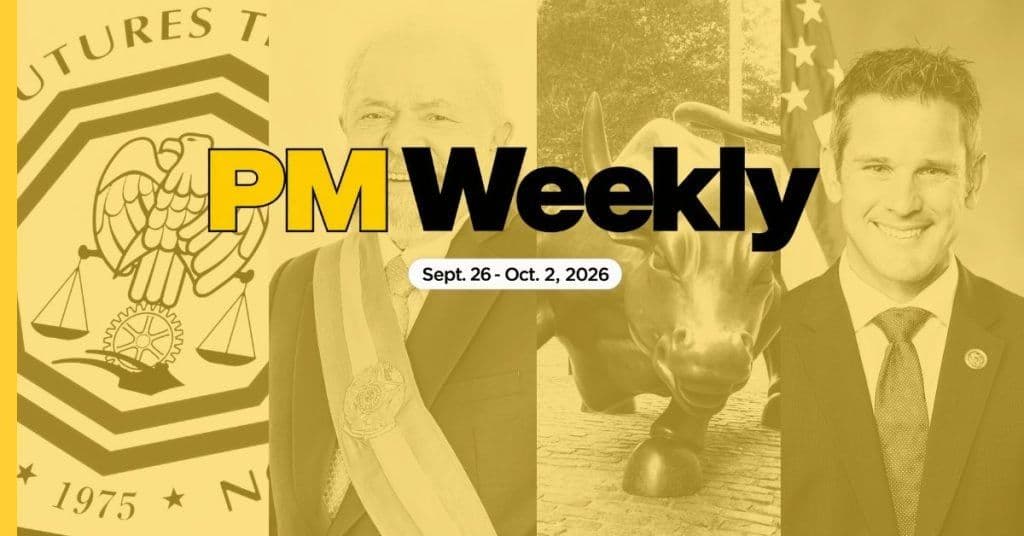
Key Takeaways
- The CFTC sent two rules to the White House: broaden the definition of swap to include event contracts and issue an interim rule excluding casino-style games.
- A U.S. district judge in Illinois granted partial injunctions to Kalshi, Coinbase and the CFTC against state attempts to regulate sports contracts.
- Kalshi is reportedly near a roughly US$1,000m funding round that could value the company at about US$40bn.
- Polymarket and polls showed divergent signals ahead of Brazil’s 4 October first round, highlighting differences between market prices and voter intention.
- The CFTC is investigating trades linked to Adam Kinzinger and multiple corporations have tightened employee trading rules to curb insider trading risks.
The CFTC this week sent two initiatives to the Executive that could redefine which contracts fall under its jurisdiction: a proposal that would broaden the definition of swap to include event contracts and an interim rule that would exclude casino-style games. At the same time, federal courts in Illinois granted partial injunctions to Kalshi, Coinbase and the Commodity Futures Trading Commission (CFTC) against state-level attempts to regulate sports contracts, and several industry firms are moving toward massive funding rounds.
I write from weekly coverage for NEXTPredict.io, reporting on legal decisions, investor appetite and the tension between prediction markets and national rules for the week of 26 September–2 October 2026.
CFTC moves the line: redefine "swap" and exclude casino games
The Commodity Futures Trading Commission sent two texts to the White House for review that take different approaches depending on contract type. The main proposed rule would expand the definition of swap to cover event-linked contracts — which would make it easier for some prediction markets to operate under a federal framework. Simultaneously, an interim rule would explicitly exclude casino-style products such as slot machines and roulette.
Timing and scope matter because appeals in different federal circuits are split on whether sports contracts and other event products should be treated as swaps. The Sixth and Ninth Circuits recently rejected Kalshi’s argument that its contracts qualify as swaps, while the Third Circuit reached the opposite conclusion earlier in 2026. After a U.S. district judge in Illinois on 2 October granted partial injunctions, the litigation now presents a renewed intra-circuit split that could affect whether the Supreme Court takes the case.
Illinois ruling favors Kalshi, Coinbase and the CFTC
A judge of the United States District Court for the Northern District of Illinois, Martha Pacold, partly granted the injunction requests filed by Kalshi, Coinbase and the CFTC against Illinois officials who tried to apply local regulation to sports contracts. The court held other parts of the petitions for further proceedings.
The decision adds another piece to the mosaic of judicial rulings: New Jersey has asked the Supreme Court to review a Third Circuit decision favorable to Kalshi, and the Illinois ruling now contrasts with a Wisconsin decision that is on appeal in the Seventh Circuit.
Funding rounds: Kalshi, Novig and strategic backers
Investor interest in the sector has not cooled. Press sources say Kalshi is close to closing a round of roughly US$1,000m that would value the company at about US$40bn, versus the US$22bn reported in its May raise. That valuation would imply roughly ten times about US$4bn in attributed annualised revenue.
Novig is also reportedly negotiating capital at a valuation of up to US$2bn, quadrupling its February US$500m valuation. In addition, Raven, a trading and market-making firm in prediction markets, secured strategic backing from Coinbase Ventures and CMCC Global with a reported pre-money valuation of US$90m.
Brazil: prediction markets and polls send different signals
With Brazil’s first presidential round scheduled for Sunday 4 October, prices on prediction platforms and traditional polls signalled different outcomes. NEXTPredict.io observed that Polymarket gave Luiz Inácio Lula da Silva a high probability to lead the first round, while its market on the ultimate winner favoured Senator Flávio Bolsonaro. Polls placed Lula slightly ahead for the first round and indicated a tighter split in a hypothetical runoff.
The divergence underlines the difference between voting intention and market expectations. The local regulatory context complicated the scene further: President Lula signed a measure banning sports betting and online casino games, and previously adopted rules limit contracts tied to sports, politics and other real-world events, leaving narrower routes for financial-style contracts.
Expansion of election products and media partners in the U.S.
Integrated political coverage with prediction markets expanded ahead of the U.S. midterms. CBS News announced a partnership with Kalshi to incorporate exchange prices into its electoral analysis. Gemini launched a dedicated political hub with markets on Senate, House and governors, interactive maps and a live news feed.
As of 1 October, Polymarket put the probability of Democratic control of the House at 93% and the Senate at 63%, figures similar to Kalshi’s. These probabilities reflect market prices, not forecasts or polls.
Risks of insider trading and corporate responses
The CFTC is investigating trades on Kalshi linked to former congressman Adam Kinzinger over whether he had inside information about a Joe Biden pardon; Kinzinger disclosed gains of US$823 and denied possessing inside information. Kalshi reported the activity in an internal review and referred it to the regulator.
Companies such as FedEx, PepsiCo and TKO updated employee policies to restrict trading on prediction markets related to confidential information, joining JPMorgan, Cisco and Goldman Sachs. The Chair of the House Oversight Committee, James Comer, expanded an inquiry that now includes Hyperliquid, Crypto.com and Aristotle Exchange.
Distribution, white-label and the international landscape
White-label models are expanding distribution of prediction markets in the United States. Plaee signed deals — including one with Optimove — that allow sportsbook and iCasino operators to offer federally regulated markets through Crypto.com | Derivatives North America, a market designated by the CFTC. ProphetX and Plaee also announced an alliance to provide access to the regulated sports exchange via a stack that includes a white-label interface and risk controls.
Axis aims to build what co-founder Alex Tomsovic called "the Shopify of prediction markets," seeking regulatory approval to let brands and creators launch markets under their own label.
We cover the rest of the week
Other key notes: Kalshi reached US$60.85bn in notional volume in September; Polymarket US added deposit limits and self-exclusion; VerdX seeks to become the first Canadian "investment dealer" dedicated to prediction markets; CME Group launched futures based on performance indexes for the NHL’s 32 teams; and a study showed Kalshi temperature markets beat the National Blend of Models in six of seven cities.
Next week brings MLB playoffs, major esports tournaments and Brazil’s potential runoff on 25 October if needed. In the U.S., the Supreme Court’s new term begins and oral arguments and hearings related to the criminal and regulatory proceedings mentioned above remain scheduled.
"These judicial decisions and the CFTC’s action shape a decisive moment for federal regulation of event contracts," said an analyst quoted by NEXTPredict.io.
For providers and operators, the immediate consequence is that the regulatory board is changing quickly: the weight of a new swap definition, attention on promotional incentives and pressure for controls against insider trading will shape investments, products and partnerships over the coming quarters.
Frequently Asked Questions
What exactly is the CFTC proposing for event contracts?
The CFTC proposed expanding the definition of "swap" to include event-linked contracts while simultaneously issuing an interim rule that would exclude casino-style games. Both initiatives were sent to the White House for review and are intended to clarify which products fall under federal jurisdiction.
What did the Illinois court rule regarding Kalshi and Coinbase?
The United States District Court for the Northern District of Illinois, before Judge Martha Pacold, granted partial injunctions to Kalshi, Coinbase and the CFTC against Illinois officials’ attempts to apply state rules to sports contracts. Other parts of the petitions were held for further proceedings.
How much capital is Kalshi seeking and what valuation is reported?
Kalshi is reportedly negotiating a funding round near ⟦IGH0S⟧US$1,000m⟦IGH0E⟧ that would place its valuation around ⟦IGH1S⟧US$40bn⟦IGH1E⟧, up from the US$22bn reported in May 2026.
How do prediction markets and polls differ in the Brazilian election?
Prediction markets such as Polymarket priced Luiz Inácio Lula da Silva as likely to lead the first round while markets on the eventual winner favoured Flávio Bolsonaro; traditional polls showed Lula slightly ahead for the first round and suggested a tighter runoff. Markets reflect trader expectations and pricing, not direct voter intention.
What steps are companies taking to prevent insider trading on prediction markets?
Companies including FedEx, PepsiCo and TKO updated employee trading policies to restrict activity on prediction markets involving confidential information, joining firms like JPMorgan, Cisco and Goldman Sachs. Regulators are also investigating suspicious trades linked to public figures.
Tags
About the author

Renata Quiroga
Betting Markets Correspondent
Renata Quiroga covers sports betting and prediction markets — sportsbook launches, odds technology, event contracts, and the regulatory calls that decide what can be bet on and where. The reports open with the product or the ruling, name operators and platforms precisely, and explain the mechanics without needless jargon. When a book enters a Latin American market or a prediction exchange lists a contested contract, Renata Quiroga reports what changes for the bettor.
More from Renata Quiroga









