Nick Spanos Urges Gaming Firms to Move Settlement and Affiliate Payouts On‑Chain
At the Payment Expert Summit Spanos advocated Lightning rails, stablecoins and AI agents settling in crypto.
Key Takeaways
- At the Payment Expert Summit on 2 October 2026 Nick Spanos urged operators to move settlement and affiliate payouts on chain.
- An affiliate network running on a blockchain can pay 700 people immediately, versus 30 days on typical operator rails.
- Spanos recommended operators run a funded Lightning-style layer and settle back to Bitcoin roughly every 10 minutes.
- Coinkite disclosed a Coldcard randomness flaw on 30 July 2026; TRM Labs and SelfCustody Labs estimate losses at about 1,816 BTC (~$116m).
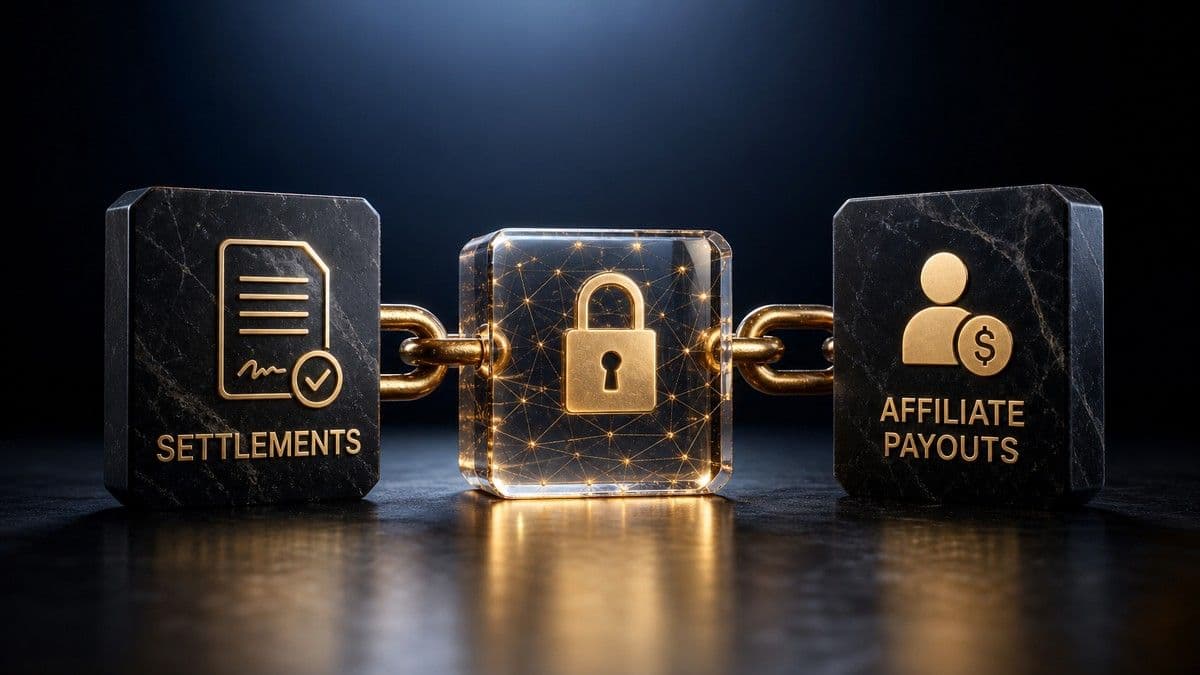
Nick Spanos told operators at the Payment Expert Summit on 2 October 2026 to move settlement and affiliate payouts on chain, arguing the change would cut days-long payment cycles to near-instant finality. He gave a concrete example: an affiliate network running on a blockchain can pay 700 people the moment a bet settles, compared with the 30 days operators commonly take to clear affiliate payments today.
Why operators should consider blockchain settlement
Spanos opened by tracing his own credentials: he founded Bitcoin Center NYC in 2013, which he calls the first live cryptocurrency exchange in the United States, sited 100 feet from the New York Stock Exchange. He also co-founded the Zap oracle protocol and appears in the Netflix documentary “Banking on Bitcoin.” His central claim was operational: gaming firms have not shifted their money on chain and risk falling behind as traditional payments firms move settlement onto stablecoin rails.
He ranked Bitcoin's base layer as the most provable chain because records on it stay "forever," but he acknowledged its early weakness in speed. That is why the Lightning Network was developed as a second layer to enable higher throughput.
How blockchain settlement speeds affiliate payouts
Spanos contrasted settlement models directly. On conventional rails, operators often wait 30 days to clear affiliate payouts. On a blockchain-based affiliate network, settlement can be immediate: 700 affiliates can receive their share the moment a bet resolves.
He argued operators can build and fund their own Lightning-style layer to run thousands of fast bets and then settle back to the Bitcoin base layer periodically — roughly every 10 minutes, he said. Between those settlements the operator could take a commission on the private layer.
Spanos’s technical comparisons and throughput claims
Spanos provided throughput figures to anchor what different networks can do. He estimated Mastercard's network at around 60,000 transactions per second at peak. He said his own chain, Cryptos.com, has tested at 12,000–18,000 transactions per second across a year, with a theoretical design ceiling of 200,000 transactions per second. Cryptos.com is currently in beta testing, he said.
He placed Bitcoin's block cadence at about every 10 minutes and the Bitcoin base-layer throughput at roughly six transactions a second. The Lightning Network is the scaling layer that addresses this gap, allowing thousands of off-chain transactions with periodic on-chain settlement.
AI betting agents and payments that are code-to-code
Spanos told the audience to plan for AI agents placing bets on behalf of users. He described a likely user flow: a gambler gives an AI agent a small crypto wallet, a strategy and a loss limit — for example, "don’t lose more than this amount, this percentage" — and lets it play while the user is unavailable.
He argued cards are a poor fit for machine-to-machine settlement. Card rails assume a human in the loop; agents will prefer crypto because it supports direct programmatic settlement. "The AI wants to use crypto because it's code to code," he said.
Randomness, oracles and a persistent weak point
Turning to game security, Spanos warned that many gaming random-number generators rely on a single oracle provided by one of two or three suppliers. He said he would "never do anything with that." Weak randomness, he said, lets attackers predict outcomes and drain a game without the operator knowing.
Spanos referenced a recent hardware-wallet incident as an illustration. Coinkite disclosed a flaw in its Coldcard wallet on 30 July 2026 after firmware bypassed the device's dedicated randomness chip for five years. TRM Labs and SelfCustody Labs assessed the losses at roughly 1,816 BTC, about $116m, taken from more than 5,200 addresses. Spanos pointed out that an AI found the weakness after years of it remaining undetected.
Examples from the market and operational implications
He cited a Solana-based dice casino to show crypto transactions operating at speed on Lightning-style or comparable rails and praised a staking model where players who stake the game's token share in the casino's results and become partial owners of the house.
On the Payment Expert Summit show floor he said he saw operators spending "tens of millions of dollars" on software that keeps data in internal silos rather than on public chains. He used the metaphor he first applied to bankers over a decade ago: operators are "dinosaurs" and "the meteor has already hit" for firms that fail to adopt on-chain settlement.
For vendors and payments teams the practical implications are clear: decisions about whether to fund private second-layer rails, integrate stablecoin settlement, offer crypto wallets or prepare for machine-to-machine payments will shape product roadmaps. Operators will also need to revisit randomness sources and oracle diversity as part of their security due diligence.
What operators should evaluate next
Operators should map these technical options against their commercial models and compliance obligations. Relevant evaluation points include:
Speed requirements: whether a custom Lightning-style layer or an existing public network meets latency and throughput targets.
Settlement cadence: how frequently to checkpoint to a base layer (Spanos suggested roughly every 10 minutes for Bitcoin-based designs).
Affiliate flows: whether immediate on-chain payout materially reduces reconciliation overhead and dispute rates.
Security architecture: removing single-oracle dependencies and auditing randomness sources after the Coinkite Coldcard disclosure.
Payments teams will need to engage compliance and risk early, because moving real-world value onto crypto rails changes AML, KYC and custody considerations. Vendors that can bridge custody, fast off-chain rails and observable on-chain settlement will be in demand.
"You can make your own lightning layer and fund it, and then you can make commissions off your own bank on there," Spanos said, describing an operator-run approach to fast betting and settlement.
Spanos left operators with a straightforward commercial warning: if you do not use the blockchain for settlement, you risk being outpaced by firms that do.
Frequently Asked Questions
What did Nick Spanos recommend for operator settlement at the Payment Expert Summit?
He recommended operators move settlement and affiliate payouts on chain and fund their own Lightning-style layer to run thousands of fast bets, settling back to Bitcoin roughly every 10 minutes.
How much faster can affiliate payouts be on a blockchain compared with current practice?
Spanos said an affiliate network on a blockchain can pay 700 people the moment a bet settles, versus operators typically taking 30 days to clear affiliate payments.
Why does Spanos believe AI betting agents will prefer crypto?
He said AI agents will favour crypto because card rails assume a human in the loop, while crypto supports direct code-to-code settlement between machine agents.
What recent security incident did Spanos cite to warn about weak randomness?
He cited Coinkite's disclosure on 30 July 2026 that Coldcard firmware had bypassed its randomness chip for five years; TRM Labs and SelfCustody Labs estimate losses at roughly 1,816 BTC, about $116m, from over 5,200 addresses.
Tags
About the author

Priya Nair
Payments Correspondent
Priya Nair covers payments and fintech in the gambling industry — processor and PSP deals, payment-method launches, crypto rails, and the compliance shifts that decide what players can actually use at the cashier. The stories lead with the deal or launch, name the companies and methods precisely, and translate the jargon into what operators and players gain or lose. From open-banking pilots to stablecoin settlement and chargeback rules, Priya Nair follows the money the industry runs on.
More from Priya Nair