Alberta Opens Regulated iGaming Market With Registration Model in July 2026
Alberta became Canada’s second province to open a regulated iGaming market by adopting a registration regime, now allowing approved operators and suppliers market entry under oversight from AGLC and AiGC.
Key Takeaways
- Alberta opened its regulated iGaming market to registered operators and suppliers on 13 July 2026.
- Market entry relies on AGLC registration and a commercial agreement with Alberta iGaming Corporate.
- 47 operators and 47 suppliers received initial approval, including major international brands.
- Alberta’s advertising regulations for online gambling are highly restrictive compared to other provinces.
- Operators face 20% GGR gambling tax and must comply with strict responsible gambling and AML standards.
Alberta formally opened its regulated iGaming market on 13 July 2026, marking a significant regulatory shift in Canada. The province adopted a registration-based model overseen by the Alberta Gaming, Liquor and Cannabis Commission (AGLC) and Alberta iGaming Corporate (AiGC), creating structured entry routes for operators and B2B suppliers. Unlike traditional licensing, Alberta’s regime requires registration for each gambling website, with further oversight of land-based casinos maintained within the province’s established charitable gaming framework.
Regulatory Structure: Alberta’s Dual Oversight Model
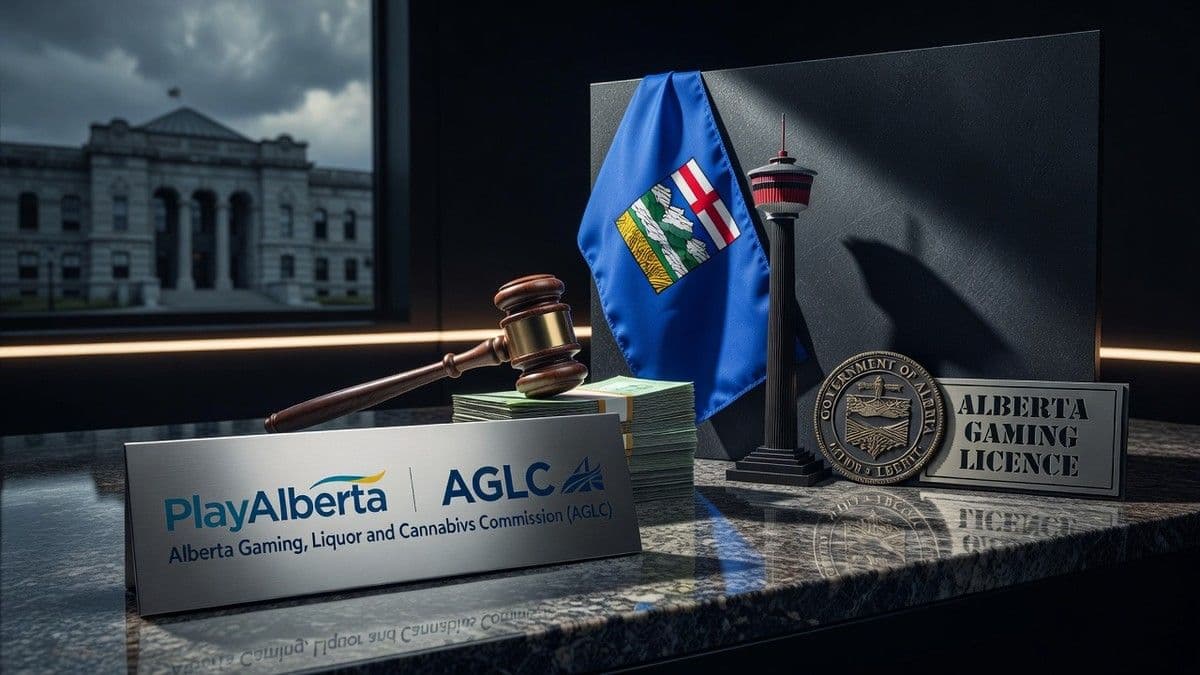
Alberta’s iGaming market is regulated by two main entities: AGLC, responsible for industry-wide oversight and facility licensing, and AiGC, managing online gambling registration and operating agreements. The province’s framework is broadly modelled on Ontario’s—though with refinements in advertising controls and operator registration. Effective 13 July 2026, Alberta officially became Canada’s second province to introduce a competitive iGaming market, welcoming both major established brands and new entrants.
Land-Based Gambling Remains Closely Linked to Charities
Land-based casinos in Alberta continue to operate under a dual licence structure. Facility licences are held by commercial operators responsible for the venue, equipment, and personnel, but individual casino events are conducted under time-limited charity licences. Charitable and religious organisations retain direct responsibility for gaming events and proceeds. New facility licences are only considered by AGLC following market demand assessments and are not available via an open process. Horse racing is regulated separately by Horse Racing Alberta (HRA), with gaming areas adjacent to racetracks subject to both AGLC and HRA oversight.
Alberta’s Online Gambling Registration Model: Entry Pathways and Requirements
Alberta distinguishes itself by implementing a registration regime for online gambling rather than a conventional operator licence. Each domain applied for must secure a separate registration, with applicants (individuals, corporations, or partnerships, including foreign companies registered in Alberta) required to pass a comprehensive suitability assessment by AGLC. This process reviews the integrity, financial position, and regulatory history of the applicant and its key associated persons.
Operators must also sign a commercial operating agreement with AiGC before launching any online gambling service. Both registration and operating agreement are mandatory for legal market entry; registration alone does not permit operations. A similar suitability review is applied to land-based facility applicants and B2B suppliers, who must additionally demonstrate ongoing compliance with technical and operational standards.
iGaming Alberta Act and Market Launch: Revenue and Initial Approvals
The legislative foundation for the competitive market rests with the iGaming Alberta Act (Bill 48). Before market launch, AGLC had approved 47 operators—including bet365, BetMGM, Caesars, FanDuel, DraftKings, and 888—and 47 B2B suppliers, such as EveryMatrix, Evolution, Play'n GO, Games Global, Continent 8, Bede Gaming, and Soft2Bet. PlayAlberta, the government-run platform, generated approximately $195 million in net revenue in 2024–25, up $25 million year-over-year. Projections suggest regulated iGaming in Alberta could generate upwards of $700 million annually, placing it among North America’s top ten jurisdictions by revenue.
Taxation, Fees, and Responsible Gambling Standards
Online Gambling Fiscal Structure
- 3% GGR social responsibility deduction
- 20% GGR gambling tax
- 8% Alberta corporate tax (plus 15% federal, total 23%)
- 5% GST
- 25% federal withholding tax on select payments
Responsible Gambling and AML Compliance
Online operators must implement robust responsible gambling programs, including self-exclusion, deposit and play limits, visible risk information, and accreditation such as RG Check. Land-based venues are required to exclude self-excluded patrons, display responsible gambling materials, and ensure staff have relevant training. AML obligations derive from federal regulations overseen by FINTRAC, with further controls imposed by AGLC and AiGC. Operators must establish comprehensive AML/KYC programs, monitor transactions, retain identification records, and ensure staff complete AGLC certification biannually.
Advertising and Marketing Restrictions in Alberta’s iGaming Market
Alberta’s advertising rules are among the most restrictive in Canada, especially for online gambling. Online operators are prohibited from publicly advertising bonuses or inducements except through their own apps or websites to opted-in players. Promotions must not target minors, use celebrities appealing to underage audiences, or present gambling as risk-free. Professional athletes and influencers may only appear in responsible gambling messaging. Land-based operators must also avoid misleading promotions, target minors, and irresponsible marketing, but face somewhat less stringent controls than online operators.
Alberta as a Case Study: Market Access and Future Considerations
The province’s open registration regime allows any qualifying operator or supplier to enter, supporting a broad initial wave of approvals. Industry consultation during market design specifically addressed the interests of land-based operators, indigenous groups, and concerns about the potential diversion of revenue from charities. The government has positioned the market to attract play away from offshore operators into the regulated space. Alberta’s dual model—open online access with restricted land-based expansion—provides a real-world experiment for policymakers across North America.
Areas for future consideration include the limits imposed on new land-based entrants and the high volume of registered operators, which may test the regulator’s supervisory capacity. An expansion of retail licensing could support greater omnichannel integration, though such reforms are not part of the current legal framework. Alberta’s evolving regulatory environment will serve as a reference point for other Canadian provinces and international jurisdictions observing the transition from monopoly to regulated, competitive gambling markets.
Frequently Asked Questions
What is the regulatory structure for Alberta's iGaming market?
Alberta’s iGaming market is regulated by the Alberta Gaming, Liquor and Cannabis Commission (AGLC) for industry-wide matters and Alberta iGaming Corporate (AiGC) for online registration and operator agreements. Both must be engaged before market entry.
How do operators enter Alberta's regulated iGaming market?
Operators must secure registration for each website from AGLC and sign a commercial operating agreement with AiGC. Only after both steps are completed can legal operations begin.
What are the key tax rates and fiscal requirements for online gambling in Alberta?
The province requires operators to pay a 3% GGR social responsibility deduction and a 20% GGR gambling tax, in addition to provincial and federal corporate taxes totaling 23%. GST and withholding taxes also apply.
Which operators and suppliers were approved for launch in Alberta?
Initial approvals included 47 operators and 47 suppliers, with operator names including bet365, BetMGM, Caesars, FanDuel, DraftKings, and 888, and suppliers like EveryMatrix, Evolution, Play'n GO, and Games Global.
How strict are Alberta’s advertising restrictions for online gambling?
Alberta imposes strict controls: bonuses and inducements may not be advertised publicly, minors cannot be targeted, celebrities and athletes may only appear in responsible gambling campaigns, and promotional terms must be clearly disclosed.
Tags
About the author

Eleanor Whitfield
Regulatory Affairs Correspondent
Eleanor Whitfield tracks gambling legislation, licensing decisions, and regulator enforcement across key markets — from the UKGC, MGA, and Germany's GGL to Spain's DGOJ and the state-by-state map in the Americas. The reporting answers three questions precisely: what changed, where, and who it affects, with jurisdictions, effective dates, and penalty figures named exactly as published. Compliance officers and operators read Eleanor Whitfield to know which rulebook moved before their next board meeting.
More from Eleanor Whitfield