Polymarket cuts international taker fees by up to 86%
The November 20 changes also reduce maker rebates and raise election-market fees.
Key Takeaways
- Polymarket International will cut taker fee coefficients by up to 86% from November 20, 2026.
- Election, finance and tech market coefficients will rise from 0.04 to 0.05, while sports stays at 0.05.
- Makers need $200,000 in 30-day weighted volume to qualify for rebates under the revised programme.
- Polymarket US uses a separate volume-tiered schedule with coefficients from 0.0695 to 0.095.
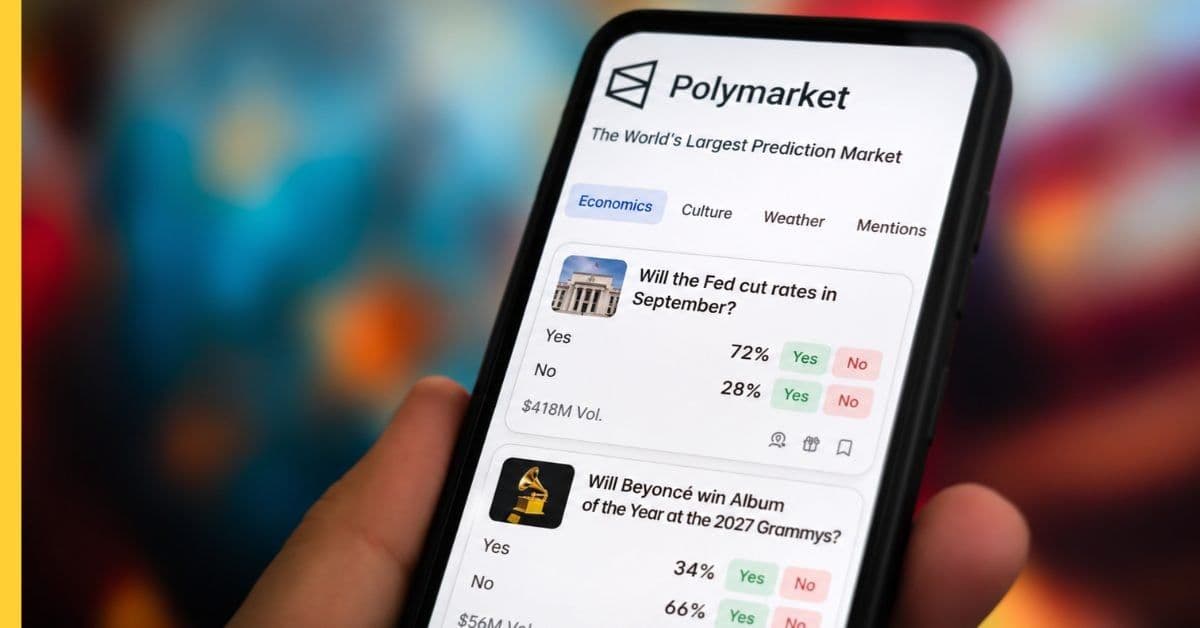
Polymarket will cut taker fees by up to 86% across seven categories on Polymarket International, effective November 20, 2026, at 23:59 UTC. The platform will lower coefficients to 0.01 from as much as 0.07, while raising rates for elections, finance and tech.
The changes apply to Polymarket International, which is closed to US traders, not Polymarket US. Takers fill orders immediately against existing orders; makers still pay no platform trading fee, but their rebates are funded by taker fees and will shrink when the fee pool falls.
Which markets are changing?
The largest cut applies to crypto contracts other than five- and 15-minute bitcoin up/down markets, whose coefficient falls from 0.07 to 0.01. Those short-term bitcoin contracts fall from 0.07 to 0.05.
Economics, culture and weather fall from 0.05 to 0.01. Mentions and politics excluding elections and geopolitics drop from 0.04 to 0.01. Polymarket announced the changes on November 17, 2026.
Elections, finance and tech move from 0.04 to 0.05. Sports, including NFL and college football, remains at 0.05, as do other/general markets and combos. A combo carries its own 0.05 coefficient regardless of its individual legs. Geopolitics remains fee-free.
How the fee formula works
Polymarket's formula remains shares × coefficient × price × (1 − price); only the coefficient changes. At a price of 50 cents, a 0.01 coefficient produces a taker fee of 0.5% of the trade value, down from 2.5% at 0.05.
Fees in dollar terms peak at 50 cents and fall toward either extreme. As a share of the amount spent, the fee is highest on a low-priced contract: the percentage is the coefficient × (1 − price). At the new 0.01 coefficient, it is approximately 1% at 5 cents, 0.5% at 50 cents and 0.05% at 95 cents.
For 100 shares in an economics, culture or weather market, the comparison is:
| Price | Trade value | Old fee, 0.05 | New fee, 0.01 | Kalshi fee, 0.07 |
|---|---|---|---|---|
| 5¢ | $5 | $0.24 (4.75%) | $0.05 (0.95%) | $0.34 |
| 50¢ | $50 | $1.25 (2.5%) | $0.25 (0.5%) | $1.75 |
| 95¢ | $95 | $0.24 (0.25%) | $0.05 (0.05%) | $0.34 |
The Kalshi figures use its standard formula of 0.07 × contracts × price × (1 − price), rounded up, under its fee schedule effective July 7. At a 50-cent price, a $1,000 taker purchase in those three Polymarket categories costs $25 before the cut and $5 after it, compared with $35 on Kalshi.
Rebate programmes change
Polymarket is removing its Bronze and Silver taker rebate levels. Accounts with less than $200,000 in 30-day weighted volume will no longer receive a taker rebate. Gold through Obsidian retain their thresholds, while a new Onyx tier returns 60% of fees above $75 million. One-time level-up bonuses end.
Makers move from daily rebate pools to volume-based tiers. Those with at least $200,000 in 30-day weighted volume earn between 3% and 15% of the taker fees generated by their fills; makers below that threshold receive nothing. Combos remain ineligible for maker rebates, and separately paid liquidity rewards do not change.
Under the current programme, makers in economics, culture and weather receive 25% of taker fees. For 100 shares filled at 50 cents, the payout falls from about $0.31 to $0.04 at the new top tier, a decline of nearly 90%. Smaller takers lose their rebate but face an 80% fee cut in those categories.
US pricing and the Kalshi comparison
Polymarket US, the exchange regulated by the Commodity Futures Trading Commission (CFTC), moved to volume-tiered coefficients of 0.0695 to 0.095 on November 14. All are higher than the international rates effective November 20. For traders below $250,000 in monthly volume, they also exceed Kalshi's 0.07.
Kalshi opened to non-US traders in October 2025. In economics, culture, weather and mentions, Polymarket International's new coefficient is one-seventh of Kalshi's; most Polymarket US takers pay more than they would on Kalshi. Economics, weather and culture account for a fraction of sports volume.
Polymarket's lower mention-market fees arrive as Kalshi pulls back from contracts on what President Trump will say on specific dates. The Wall Street Journal reported Tuesday that Kalshi halted those contracts after the CFTC ordered a pause Friday over manipulation concerns. The newspaper said mention markets attract relatively little trading but considerable public interest.
A Kalshi spokesperson told CBS News the company is:
“complying with the order.”
Polymarket International is not subject to that order. The Wall Street Journal also reported that the CFTC has opened a wide-ranging investigation into Polymarket.
In its November 17, 2026 announcement, Polymarket described its international offering as:
“doubling down” on its “unmatched breadth of markets.”
NEXTPredict.io sought comment from Polymarket on its US schedule and the increases for elections, finance and tech. Kalshi could cut its rates or rely on makers shifting quotes toward its exchange as Polymarket rebates fall; thinner Polymarket books could leave traders willing to pay more for depth.
Frequently Asked Questions
How are Polymarket trading fees calculated?
Polymarket multiplies shares by the fee coefficient, the contract price and one minus that price. At a 50-cent price, a 0.01 coefficient amounts to 0.5% of the trade value.
What happens to Polymarket taker rebates?
Bronze and Silver taker rebates are being removed, and a new Onyx tier returns 60% of fees above $75 million. Gold through Obsidian retain their thresholds, while one-time level-up bonuses end.
How do Polymarket's new rates compare with Kalshi's?
Polymarket International's 0.01 coefficient in economics, culture, weather and mentions is one-seventh of Kalshi's standard 0.07. A $1,000 purchase at 50 cents in an economics, culture or weather market costs $5 under the new Polymarket rate, compared with $35 on Kalshi.
Why did Kalshi halt some Trump mention contracts?
Kalshi halted contracts on what President Trump would say on specific dates after the CFTC ordered a pause over manipulation concerns. The Wall Street Journal reported the halt, and a Kalshi spokesperson told CBS News the company was complying with the order.
Tags
About the author

Tessa Coleman
Betting Markets Correspondent
Tessa Coleman covers betting products and markets — sportsbook launches, odds and trading technology, and the fast-growing prediction-market space from regulated exchanges to event contracts. The stories lead with the product or the ruling, name the operators and platforms precisely, and translate trading jargon into what bettors can actually do. When a book reworks its pricing or a prediction market wins a license fight, Tessa Coleman explains the mechanics and the stakes.
More from Tessa Coleman