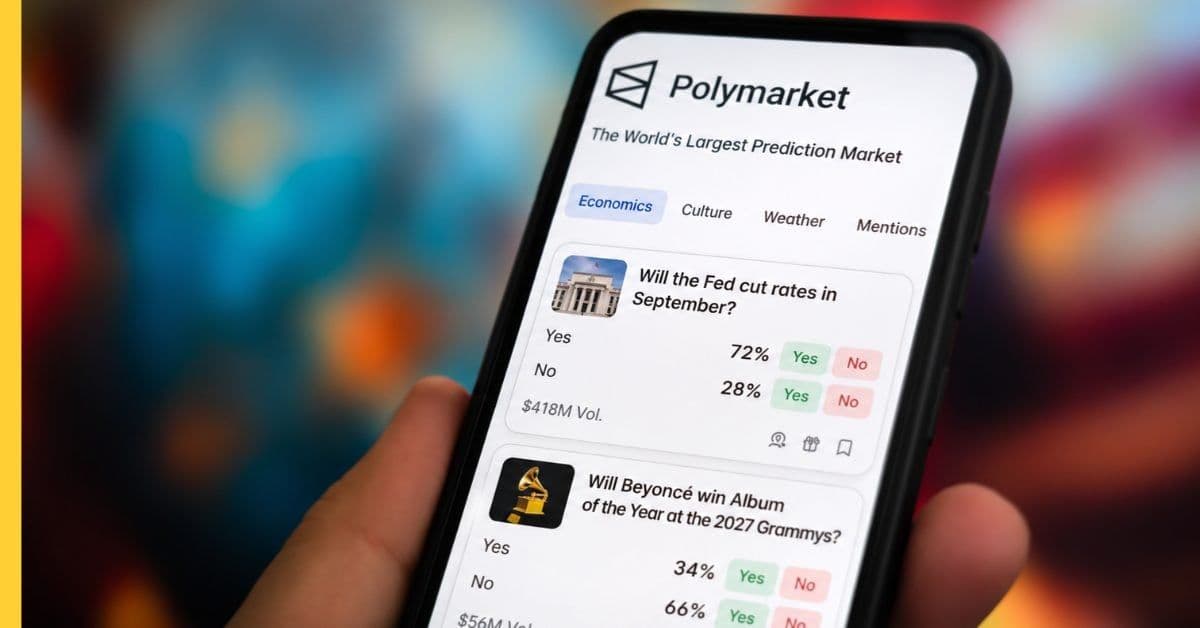
Polymarket cuts international fees by up to 86%
The cut benefits takers but reduces incentives paid to makers.
Key Takeaways
- Polymarket International will cut taker fees by up to 86% across seven categories from November 20, 2026.
- Fees for elections, finance and technology will rise from a coefficient of 0.04 to 0.05.
- Makers will need US$200,000 in weighted 30-day volume to qualify for rebates on their executions.
- Polymarket US retains a volume-based scale with coefficients from 0.0695 to 0.095.
- Kalshi suspended contracts on statements by President Trump after the CFTC ordered a pause.
Polymarket will cut taker fees by up to 86% across seven categories on its international platform from Friday, November 20, 2026, at 23:59 UTC. The coefficient will fall to 0.01 from levels as high as 0.07, according to company documentation. Three categories, including elections, will see increases.
Which markets are changing fees
The reduction covers economics, culture, weather, mentions, politics excluding elections, and all cryptocurrency markets except five- and 15-minute Bitcoin up-or-down contracts. The reduced categories currently have coefficients ranging from 0.04 to 0.07. Fees for five- and 15-minute Bitcoin contracts will fall from 0.07 to 0.05.
Sports, parlays and general markets will retain the 0.05 coefficient. Parlays will keep that fee regardless of the categories of their selections. Geopolitics will remain fee-free. Finance, technology and elections will rise from 0.04 to 0.05; therefore, the announced reduction for politics does not include elections.
The table shows current coefficients and those scheduled to take effect on November 20 on Polymarket International:
| Category | Current | From November 20 |
|---|---|---|
| Cryptocurrency, other markets | 0.07 | 0.01 |
| Bitcoin, five- and 15-minute up or down | 0.07 | 0.05 |
| Economics | 0.05 | 0.01 |
| Culture | 0.05 | 0.01 |
| Weather | 0.05 | 0.01 |
| Mentions | 0.04 | 0.01 |
| Politics, excluding elections and geopolitics | 0.04 | 0.01 |
| Elections | 0.04 | 0.05 |
| Finance | 0.04 | 0.05 |
| Technology | 0.04 | 0.05 |
| Sports, including the NFL and college football | 0.05 | 0.05 |
| Parlays | 0.05 | 0.05 |
| Other or general | 0.05 | 0.05 |
| Geopolitics | 0 | 0 |
On November 17, 2026, Polymarket published the category changes on its @Polymarket account and noted that sports and parlays would remain at 0.05. The company also announced the update with the following message:
“Lower fees, new incentives and more opportunities to trade. We’re doubling down on what makes Polymarket International special: an unparalleled breadth of markets covering practically anything worth predicting.” — Polymarket, @Polymarket, November 17, 2026.
How a trade’s cost is calculated
Takers are traders whose orders execute immediately against existing orders in the book. Polymarket’s formula is unchanged: shares × coefficient × price × (1 − price). Only the coefficients are changing. At 0.01, a purchase at 50 cents pays 0.5% of the trade value, compared with 2.5% at 0.05.
In dollar terms, the fee is highest at 50 cents and decreases towards the extremes. As a proportion of the amount spent, the formula is equivalent to coefficient × (1 − price), so low-probability contracts pay a higher percentage. With a 0.01 coefficient, the fee is about 1% at 5 cents, 0.5% at 50 cents and 0.05% at 95 cents.
For 100 shares in economics, culture or weather, the comparison is as follows:
| Price | Trade value | Previous fee, 0.05 | New fee, 0.01 | Kalshi, 0.07 |
|---|---|---|---|---|
| 5 cents | US$5 | US$0.24 (4.75%) | US$0.05 (0.95%) | US$0.34 |
| 50 cents | US$50 | US$1.25 (2.5%) | US$0.25 (0.5%) | US$1.75 |
| 95 cents | US$95 | US$0.24 (0.25%) | US$0.05 (0.05%) | US$0.34 |
Kalshi amounts use its standard taker formula —0.07 × contracts × price × (1 − price)— rounded up, in line with its fee schedule in effect since July 7. At a price of 50 cents, a US$1,000 purchase in those three categories currently costs US$25 on Polymarket and will cost US$5 after the cut, compared with US$35 on Kalshi.
Fewer rebates for takers and makers
Polymarket has also changed both of its rebate programmes. For takers, it is eliminating Bronze and Silver: accounts with less than US$200,000 in weighted 30-day volume will no longer receive rebates. Gold through Obsidian tiers retain their thresholds, while the new Onyx tier returns 60% of fees above US$75 million. One-off bonuses for moving up a tier are ending.
Makers will continue to pay no trading fee to the platform, but their rebates are funded by taker fees. The programme is moving from daily pools to volume-based tiers. At least US$200,000 in weighted 30-day volume will qualify them to receive 3% to 15% of the fees generated by their executions; below the threshold, they will receive nothing. Parlays will continue to generate no maker rebates.
The current programme gives makers 25% of taker fees in economics, culture and weather. For 100 shares executed at 50 cents, the rebate falls from about US$0.31 to US$0.04 at the new maximum tier, nearly 90% less. Liquidity rewards, which are paid separately, are unchanged. For small takers, losing the rebate is minor compared with an 80% fee cut.
Two platforms and the comparison with Kalshi
The change applies only to Polymarket International, which is closed to US traders. It does not affect Polymarket US, the platform regulated by the Commodity Futures Trading Commission (CFTC), which adopted a volume-based scale on November 14 with coefficients from 0.0695 to 0.095. All of these exceed the international fees taking effect on November 20. For traders doing less than US$250,000 a month, they also exceed Kalshi’s 0.07.
Kalshi opened its platform to traders outside the United States in October 2025. In economics, culture, weather and mentions, takers on Polymarket International will pay about one-seventh of Kalshi’s fee. In the United States, the reverse is true: most Polymarket US takers pay more than they do on Kalshi.
The cut in mentions fees comes as Kalshi reduces its presence in that category. According to The Wall Street Journal, Kalshi suspended contracts on what President Trump would say on specific dates after the CFTC ordered a pause on Friday over manipulation concerns. The newspaper reported this on Tuesday, the same day as Polymarket’s announcement. A Kalshi spokesperson told CBS News:
“We are complying with the order.” — Kalshi spokesperson.
The Wall Street Journal noted that mentions markets attract relatively little trading but disproportionate public interest. Polymarket International is not subject to that order and can continue expanding the category. The newspaper also reported that the CFTC had opened a wide-ranging investigation into Polymarket.
NEXTPredict.io requested comment from Polymarket on its US fee schedule and the increases for elections, finance and technology. Outside the United States, Kalshi could match the fees or rely on affected makers moving their quotes to its platform. For now, the main price competition is limited to international traders in economics, weather and culture, categories that account for a fraction of sports volume.
Frequently Asked Questions
How is a trade fee calculated on Polymarket?
The fee is calculated by multiplying shares by the coefficient, price and one minus the price. At a 0.01 coefficient, a purchase at 50 cents pays 0.5% of the trade value, compared with 2.5% under the previous 0.05 coefficient.
Which Polymarket categories keep their fees unchanged?
Sports, parlays and general markets retain the 0.05 coefficient, while geopolitics remains fee-free. The fee for parlays does not change based on the categories of their selections.
What is changing in Polymarket taker rebates?
Polymarket is eliminating the Bronze and Silver tiers, and accounts below US$200,000 in weighted 30-day volume will no longer receive rebates. Gold through Obsidian keep their thresholds, while the new Onyx tier returns 60% of fees above US$75 million.
How much will trading on Polymarket cost compared with Kalshi?
A US$1,000 purchase at 50 cents in economics, culture or weather will cost US$5 on Polymarket International after the cut, compared with US$35 on Kalshi. Kalshi’s calculation uses its standard 0.07 coefficient and fee schedule in effect since July 7.
Tags
About the author

Renata Quiroga
Betting Markets Correspondent
Renata Quiroga covers sports betting and prediction markets — sportsbook launches, odds technology, event contracts, and the regulatory calls that decide what can be bet on and where. The reports open with the product or the ruling, name operators and platforms precisely, and explain the mechanics without needless jargon. When a book enters a Latin American market or a prediction exchange lists a contested contract, Renata Quiroga reports what changes for the bettor.
More from Renata Quiroga